
A heat pump can cut the reliance on gas, improve everyday comfort and make a property ready for lower-carbon living. But the choice between ground source versus air source is not simply about which system is more efficient. The right answer depends on your available space, building fabric, heating demand, budget and plans for the property over the years ahead.
For most UK homes, an air source heat pump is the practical route into renewable heating. Ground source systems can deliver excellent performance, but they need more land, more groundwork and a larger upfront investment. Understanding where each technology fits helps you spend wisely rather than pay for capacity or complexity you do not need.
How the two heat pump systems work
Both technologies move heat rather than generate it by burning fuel. They collect low-grade heat from the environment, raise its temperature and use it to heat radiators, underfloor heating and hot water. Because they use electricity to move several units of heat for every unit of electricity consumed, they can be far more efficient than conventional electric heating.
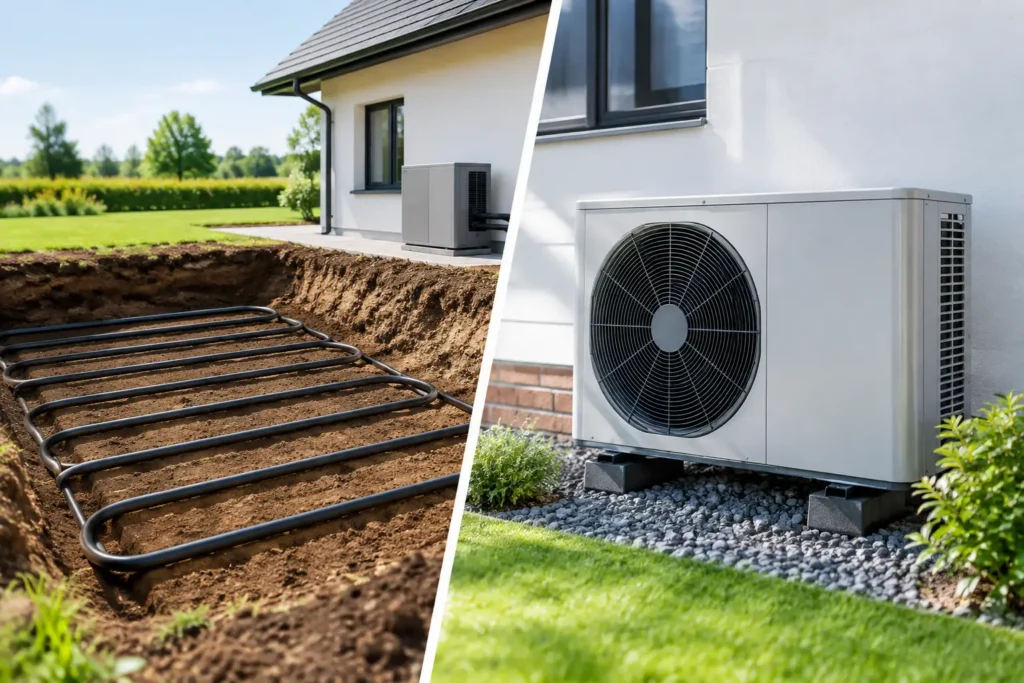
An air source heat pump takes heat from the outside air through a unit installed beside the property. Even when the weather is cold, there is usable heat in the air. The system transfers that energy indoors through a refrigeration cycle and distributes it through a wet central heating system.
A ground source heat pump collects heat from the earth instead. Pipes are installed in trenches across a suitable area of land, or placed in vertical boreholes. A fluid circulating through the ground loop absorbs stable underground heat and carries it back to the heat pump.
The key difference is temperature consistency. Air temperatures can vary sharply through a British winter, while the ground stays relatively stable below the surface. That gives ground source systems a potential efficiency advantage, particularly during prolonged cold spells. It does not automatically make them the best purchase for every property.
Ground source versus air source: the practical differences
The decision usually comes down to installation conditions and total project cost before it comes down to technical performance.
Space and installation work
An air source heat pump needs an outdoor unit with clear airflow, sensible positioning and enough room for engineers to access it. It is often installed at the side or rear of a house, and can be suitable for many homes, conversions, small commercial premises and new-build properties. Planning rules may apply in some locations, especially for listed buildings or properties in conservation areas, so this should be checked before work begins.
Ground source requires space for the collector array or access for drilling equipment. Horizontal trenches need a substantial clear garden or land area, while boreholes require specialist surveying and drilling. Ground conditions, underground services, access for machinery and landscaping reinstatement all affect feasibility and cost.
For a property with a modest garden in Leicester or another built-up area, air source is normally the more straightforward option. Ground source becomes more attractive for larger rural homes, farms, estates, new developments and commercial sites with land available for the ground loop.
Upfront cost
Air source heat pumps generally cost less to install because there is no excavation or borehole drilling. The final price still depends on the size of the system, whether a hot water cylinder is required, electrical upgrades, pipework changes and the condition of the existing heating system.
Ground source heat pumps cost more at the outset, mainly because of the collector installation. Drilling deep boreholes or excavating trenches is a major part of the project, and site surveys are essential. While the long-term performance can be very strong, the additional capital cost means ground source is usually best assessed as a long-term property investment rather than a quick payback measure.
Available grants and finance options can change the figures, but incentives should support a good design, not drive the decision. A properly sized system, installed to recognised standards, matters more than choosing the system with the lowest headline quote.
Efficiency and running costs
Ground source systems can achieve consistently high efficiency because underground temperatures are more stable than outdoor air temperatures. This can make them particularly effective where a property has a high annual heat demand and the system will run for many years.
Modern air source heat pumps are also highly efficient when specified and installed correctly. Their performance is strongest in well-insulated homes with emitters designed for lower flow temperatures. They will work harder in very cold weather, but that does not mean they stop working. A quality system is designed around winter conditions, not just mild autumn days.
Running costs depend on more than the heat pump itself. Electricity tariff, insulation levels, hot water use, radiator sizing, heating controls and household habits all have an impact. Pairing a heat pump with solar panels and battery storage can further reduce the cost of purchased electricity, particularly where daytime generation can be used intelligently.
Noise and appearance
Air source units contain a fan, so some operating sound is unavoidable. Modern units are much quieter than older equipment, and correct siting makes a significant difference. An experienced installer will consider boundaries, bedroom windows, neighbouring properties and airflow rather than treating the outdoor unit as an afterthought.
Ground source systems have no external fan unit. Much of the infrastructure is underground, which may suit homeowners who want minimal visual impact once installation is complete. However, the temporary disruption during groundworks can be significant, especially with trench-based systems.
Your property matters as much as the heat pump
A heat pump should never be selected from floor area alone. Every property needs a heat-loss calculation to establish how much heat it requires at the coldest design temperature. This calculation informs the heat pump size, radiator requirements, cylinder capacity and likely running performance.
Insulation is especially important. Loft insulation, cavity wall insulation where suitable, draught reduction and quality glazing can all lower heat demand. Heat pumps deliver steady, efficient warmth rather than the short, high-temperature bursts associated with some older boilers. A well-insulated building holds that heat for longer and gets better value from the system.
Existing radiators may be suitable, but some properties need larger radiators or underfloor heating to provide the same comfort at lower water temperatures. Underfloor heating is an excellent match for either ground or air source heat pumps because it uses a large surface area and can operate efficiently at low temperatures.
A hot water cylinder is also commonly required. This can be a concern where space is tight, but it provides reliable stored hot water and allows the system to operate efficiently. In many upgrades, careful cylinder and pipework planning is as important as choosing the heat pump itself.
When air source is usually the better choice
Air source heat pumps suit a wide range of UK properties because they offer a strong balance of cost, performance and installation practicality. They are often the preferred solution for homeowners replacing an ageing gas, oil or electric heating system, as well as landlords improving EPC performance.
They are particularly compelling where the property has limited land, reasonable outdoor access and a heating system that can be upgraded for lower-temperature operation. For a household looking to reduce bills and carbon emissions without major excavation, an air source heat pump is usually the sensible starting point.
They also integrate well with other home energy improvements. Solar PV can supply part of the electricity demand, battery storage can help retain more solar generation, and smart controls can schedule heating and hot water around the most cost-effective times.
When ground source can be worth the investment
Ground source heat pumps are a strong option where there is sufficient land, stable long-term occupancy and a higher heat requirement. They can be particularly suitable for detached rural homes off the gas grid, substantial renovations, self-build projects and commercial properties with the site conditions to support ground loops or boreholes.
They also make sense when major groundwork is already planned. If a site is being developed, landscaped extensively or fitted with new services, incorporating the ground collector at that stage may be more cost-effective than retrofitting it later.
The main question is not whether ground source is technically superior. In the right setting, it often is. The question is whether its additional installation cost and disruption produce enough long-term value for your property and usage.
Get the design right before comparing quotes
The most useful comparison is between properly designed proposals, not between two headline prices. Ask whether the quote includes a room-by-room heat-loss survey, radiator or underfloor heating assessment, hot water cylinder design, electrical requirements, controls and commissioning. You should also understand what site preparation, groundworks or reinstatement is included.
MCS certification is an important consideration for eligible installations and gives added confidence that design and installation standards are being followed. It is also worth choosing an installer that can look at the wider energy picture, including solar, storage, ventilation and heating controls, rather than treating each system in isolation.
For most properties, the best low-carbon heating system is the one that fits the building, the budget and the way people actually live in it. A considered survey will show whether air source offers the right balance or whether the long-term advantages of ground source justify going further.