
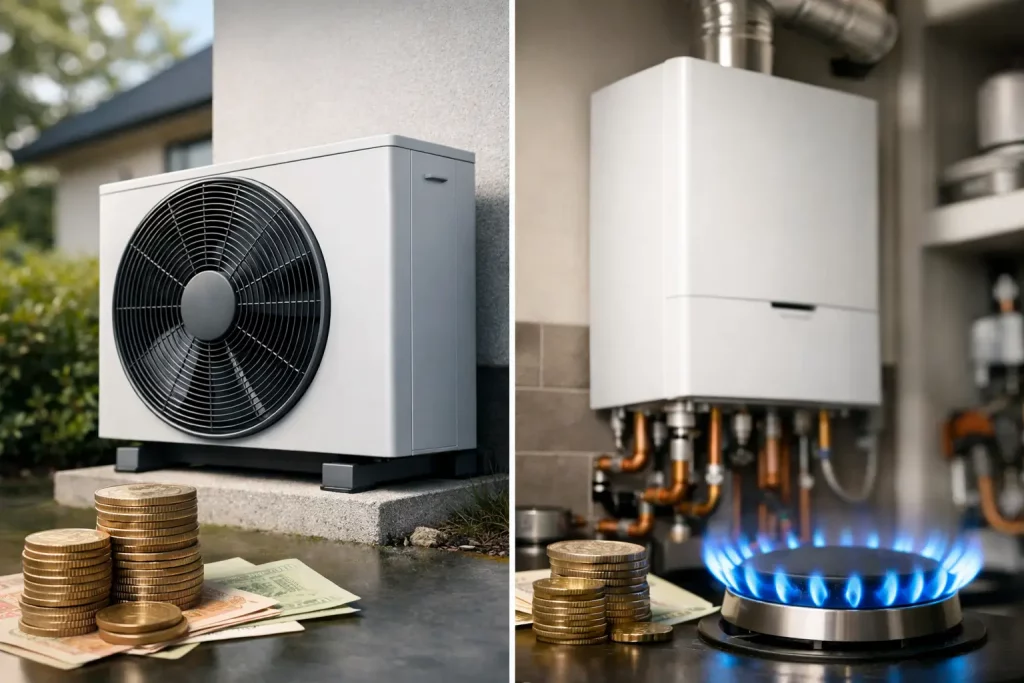
A £1,200 annual gas bill can make a heat pump look expensive at first glance, particularly when electricity costs more per unit than gas. But heat pump vs gas boiler running costs are not decided by unit prices alone. The key question is how much usable heat each system produces from the energy it buys.
For many well-suited UK homes, an air source heat pump can reduce heating running costs or keep them competitive with a modern gas boiler. In others, especially properties with high heat loss, unsuitable radiators or poor controls, the saving may be limited until efficiency improvements are made. A proper assessment matters far more than a headline claim.
Why electricity can cost more but a heat pump can still save money
A gas boiler burns fuel to create heat. Even an efficient modern condensing boiler typically converts around 90% of the gas it uses into useful heat over a year. For every 10 kWh of gas purchased, roughly 9 kWh reaches your radiators and hot water cylinder.
A heat pump does not create heat by burning fuel. It draws low-grade heat from the outdoor air and uses electricity to move it indoors. This is why its efficiency can be above 100%. A heat pump with a seasonal coefficient of performance, or SCOP, of 3 produces around 3 kWh of heat for every 1 kWh of electricity used across the heating season.
That difference changes the maths. If electricity costs roughly three times as much as gas per kWh, a heat pump operating at a SCOP of 3 can be broadly comparable on space-heating costs to a gas boiler. If it achieves a higher seasonal efficiency, or if electricity is bought on a favourable tariff, it can cost less to run.
The calculation is straightforward:
Cost per kWh of heat = energy unit price divided by system efficiency.
For example, gas at 7p per kWh used in a 90% efficient boiler costs around 7.8p per kWh of useful heat. Electricity at 25p per kWh used by a heat pump with a SCOP of 3.5 costs around 7.1p per kWh of useful heat. Prices change, but the principle does not.
Heat pump vs gas boiler running costs in a typical home
Every property has a different annual heat demand, so there is no single bill that applies to every household. A compact, well-insulated new-build may need far less heat than a large detached period home. Household temperature preferences, hot water use and whether rooms are heated all day also make a meaningful difference.
As an illustration, consider a home needing 12,000 kWh of useful heat each year for space heating and hot water. With a gas boiler operating at 90% efficiency, it would need around 13,300 kWh of gas. With a heat pump running at a seasonal efficiency of 3.2, it would need around 3,750 kWh of electricity.
At the unit rates above, the gas cost would be about £930 a year, while the heat pump electricity cost would be about £940. That is close enough for tariffs, system performance and lifestyle to decide the outcome. A heat pump achieving a SCOP of 3.8, or using lower-cost overnight electricity for some hot water heating, would shift the result in its favour.
This is why claims that heat pumps are always cheaper, or always more expensive, are both too simplistic. The outcome depends on the price ratio between gas and electricity, the heat pump design, and how efficiently the building holds onto warmth.
The standing charge should not be ignored
If a home is fully electric and the gas supply is no longer needed, removing the gas standing charge can improve the overall financial case. That saving is separate from heating efficiency and can add up over the year.
However, households that keep gas for cooking or another appliance will continue paying that standing charge. This should be included when comparing whole-house energy bills rather than heating costs alone.
What makes a heat pump cheaper to run
A well-designed heat pump system is not simply an outdoor unit replacing a boiler. Its running cost is shaped by the whole heating system.
Low flow temperatures make the biggest difference
Gas boilers are often set to send very hot water to radiators. Heat pumps work most efficiently at lower flow temperatures, commonly around 35°C to 50°C depending on the property. The lower the temperature needed to keep rooms comfortable, the less electricity the heat pump generally uses.
Underfloor heating is particularly well matched to heat pumps because it operates at low temperatures over a large surface area. Larger modern radiators can achieve a similar result in properties without underfloor heating. This does not always mean replacing every radiator, but radiator sizing should be checked room by room as part of the design.
Insulation cuts demand before energy is bought
Loft insulation, cavity wall insulation where suitable, draught reduction and better glazing reduce the amount of heat a home loses. That lowers bills with either system, but it also allows a heat pump to run at lower temperatures and higher efficiency.
A heat pump does not require a perfectly insulated property. Many older UK homes can use one successfully. But a poorly insulated home will need a larger system, use more energy and may need improvements to deliver the comfort and savings expected.
Controls and everyday use matter
Heat pumps are usually best run steadily rather than switched on for short bursts at high temperature. Maintaining a consistent indoor temperature allows the system to work gently and efficiently. Smart controls, weather compensation and correctly balanced radiators help it respond to outdoor conditions without wasting energy.
This can feel different from living with a gas boiler. Instead of waiting for a rapid blast of heat, the home stays at a more stable temperature. For most households, that improves comfort as well as helping manage running costs.
When a gas boiler may cost less to run
A new, well-maintained gas boiler can still be economical to operate in some circumstances. If a property has very high heat loss, small radiators designed for high temperatures and no scope for improvement, a heat pump may have to work harder. Its SCOP could fall enough for gas to be cheaper at prevailing tariff rates.
The same is true where a heat pump is undersized, poorly commissioned or controlled like a boiler. Installation quality is critical. A system should be designed using an accurate room-by-room heat-loss calculation, with suitable emitters, pipework, hot water provision and controls.
Gas may also remain the lower-cost option for owners looking only at immediate annual fuel spend and not at wider factors. A boiler replacement generally has a lower upfront cost than a full heat pump installation, although available support and the condition of the existing system can change that comparison.
For landlords, developers and businesses, the decision may additionally involve future compliance, EPC performance, tenant comfort, maintenance planning and carbon targets. Running cost is essential, but it is not the only cost worth measuring.
Solar panels, batteries and heat pump running costs
A heat pump becomes more attractive when it is part of a wider energy plan. Solar panels can generate electricity during daylight hours, including useful output in spring and autumn when heating demand remains significant. That self-generated electricity can reduce the cost of running the heat pump, particularly for daytime heating and hot water production.
A battery can store surplus solar generation for later use, though its value depends on household demand patterns, battery size and electricity tariff. Time-of-use tariffs can also help households charge a battery or heat hot water when electricity is less expensive, then use that energy at higher-price periods.
There is no need to install every technology at once. The sensible route is to assess the building first, then choose measures that work together. Airtech Renewables can design integrated systems that consider heating, hot water, solar generation and storage as one practical plan rather than separate purchases.
Get a meaningful cost comparison before choosing
The most reliable comparison starts with your actual annual gas use, electricity tariff, property size and insulation levels. From there, a heat-loss survey can identify the heat pump size required, likely flow temperatures and whether any radiators need upgrading. It should also estimate seasonal performance rather than relying on a best-case laboratory figure.
Ask for projected annual electricity consumption, not just a headline efficiency percentage. Compare this with the gas needed by your existing boiler or a proposed replacement, then account for standing charges, maintenance, future tariff options and any planned solar installation.
A heat pump is not a magic answer to every high bill. It is a highly efficient heating system when it is properly matched to the property. If your home is ready, or can be made ready with targeted upgrades, the lower-carbon choice can also become the more controllable long-term cost.