
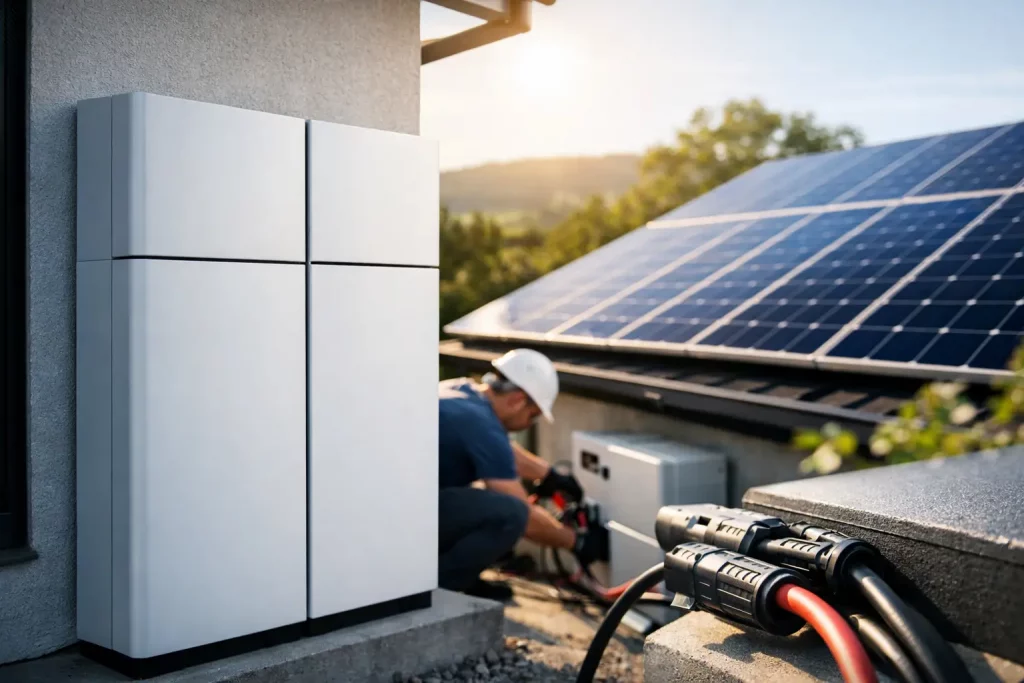
Your solar panels may generate plenty of low-cost electricity at midday, just when your property needs it least. Battery storage changes that pattern. It holds unused solar power for the evening, allowing you to use more of the energy you generate rather than exporting it to the grid. If you are considering how to add battery storage, the right approach depends on your existing system, electricity use and the result you want from the investment.
What battery storage adds to a solar system
A solar battery stores electricity generated by your panels that is not being used immediately. When generation drops later in the day, the battery can supply your home or business before you need to buy electricity from the grid.
For many UK properties, the biggest benefit is greater solar self-consumption. Without a battery, a large share of solar generation can be exported during daylight hours. With storage, that surplus can be used for cooking, lighting, appliances, home working and charging devices after the sun has gone down.
A battery can also charge from cheaper off-peak grid tariffs where this suits your tariff and usage. This can be particularly useful during winter, when solar output is lower. However, a battery is not a replacement for the grid in every situation. Its value comes from reducing the amount of high-cost electricity you need to import, not from producing electricity itself.
How to add battery storage to an existing solar system
Adding a battery to an existing solar installation is usually straightforward, but it should begin with a site survey and a review of your system design. An experienced installer will check your inverter type, panel capacity, consumer unit, available wall space and current electricity consumption.
Most retrofit battery installations use an AC-coupled battery. This means the battery has its own inverter and connects to your property’s electrical system separately from the existing solar inverter. It is a flexible option because it can work with many established solar PV systems without replacing equipment that is still performing well.
If you are installing solar panels and battery storage together, a hybrid inverter may be the better choice. This combines the solar and battery functions in one unit, creating a tidy, efficient system from the outset. The best option is not always the one with the lowest initial price. Keeping a reliable existing inverter can make sense, while a system that needs upgrading soon may justify a more integrated design.
Your installer should also manage the required network notification or application with the local Distribution Network Operator. This confirms that the new equipment can connect safely to the electricity network. Electrical work must be completed to the appropriate standards, with certification provided once the installation is complete.
Choosing where the battery will go
Battery units are often installed in a garage, utility room, plant room or other suitable internal space. Some products can be fitted outdoors, provided the location meets the manufacturer’s requirements. The position needs adequate clearance, a secure mounting surface and sensible access for future servicing.
Avoid choosing a location only because it is hidden away. Very cold or very hot conditions can affect battery performance, and the system must remain accessible. A good installer will recommend a practical position that protects the equipment without disrupting everyday use of the property.
Choose battery capacity around your real electricity use
Battery size is measured in kilowatt-hours, or kWh. It tells you how much electricity the unit can store. A larger battery can hold more solar generation, but oversizing it can increase the upfront cost without delivering proportionate savings.
The starting point is your electricity profile. Look at how much power you use in the late afternoon and evening, when solar generation is falling. A household with modest daytime use and regular evening demand may benefit from a different capacity to a property with an electric vehicle, air conditioning, electric cooking or a heat pump.
As a broad guide, many homes consider storage in the region of 5kWh to 15kWh, but there is no universal ‘right’ size. A smaller battery may cycle regularly and provide a strong return where electricity use is moderate. A larger unit can be worthwhile where there is substantial solar generation, high evening demand or planned electrification.
For businesses, demand patterns matter even more. A site operating mainly during daylight hours may already use much of its solar power directly. A business with evening operations, refrigeration, workshop equipment or shift work may gain more from storage. Usage data, rather than assumptions, should guide the design.
Capacity is not the only figure that matters
Pay attention to usable capacity, power output and warranty, not just the headline kWh figure. Usable capacity is the amount of stored energy available for everyday use. Power output affects how much electricity the battery can supply at one time.
This matters when several high-demand appliances run together. A battery may have sufficient stored energy but still be limited in how quickly it can deliver it. Your system should be designed around the loads you expect to cover, particularly if you are planning an EV charger, heat pump or other electric upgrades.
Battery warranties commonly cover a stated number of years, a throughput limit or a retained capacity level. Product quality and the installer’s aftercare should carry real weight in your decision. The cheapest unit is not automatically the best long-term value.
Decide whether you need backup power
A common misunderstanding is that every solar battery keeps a property powered during a power cut. In most standard installations, it does not. Grid-connected solar systems are designed to shut down during an outage as a safety measure, including when a battery is installed.
Backup capability requires additional equipment and a system designed specifically for it. Depending on the product and property, this may provide power to selected essential circuits, such as lighting, broadband, refrigeration and sockets, or it may support a wider part of the building.
Backup adds cost and design considerations, so it is best treated as a deliberate requirement rather than an assumed feature. If resilience is important to your household or business, raise it at the survey stage. It is much easier to plan essential-load circuits before the installation than to make changes afterwards.
Make battery storage work with your wider energy plans
Battery storage delivers the strongest results when it forms part of a joined-up energy plan. Solar panels generate the electricity, the battery shifts it to more useful hours, and smart controls help direct it to the best use.
For example, an EV charger can be scheduled around lower-cost periods or surplus solar. A heat pump can run more economically when controls, insulation and hot water storage are considered together. A hot water cylinder can also act as a form of thermal storage, holding solar-generated energy as hot water rather than electricity.
This does not mean every property needs every technology. It means the battery should not be chosen in isolation. Future plans can affect the size and layout you choose today. If you expect to buy an electric vehicle, extend the property or replace a boiler with a heat pump, allowing for that demand now can avoid an undersized system later.
What affects the cost and payback?
The installed cost of battery storage varies with capacity, brand, power rating, installation complexity and whether other electrical work is required. A retrofit system may need additional protection equipment, consumer unit upgrades or changes to accommodate the battery safely.
Payback depends on your solar surplus, import tariff, export rate and the way you operate the battery. A household that exports large amounts of solar power and buys expensive electricity each evening may see stronger savings than one that is empty through the day or already consumes most solar generation directly.
There are trade-offs. Charging a battery from the grid on a low-rate tariff can reduce costs, but it should be set up carefully to avoid charging at the wrong times. Export payments can make it worthwhile to export some electricity rather than store every unit. Smart controls and regular monitoring help the system respond to your priorities.
Work with a qualified installer
Battery storage is a significant electrical upgrade, not a plug-in appliance. The design should account for your existing solar equipment, electricity demand, property layout and future plans. Ask for a clear explanation of the proposed capacity, expected operating approach, warranty and any work needed for backup power.
Choosing an MCS-certified installer also provides reassurance that your renewable energy system is being designed and fitted to recognised standards. At Airtech Renewables, we look at how solar, storage, EV charging and low-carbon heating can work together, helping customers invest in technology that fits their property rather than a one-size-fits-all package.
The best time to add battery storage is when you can use the information from your own energy habits to make a measured choice. A well-sized system will quietly store more of your lower-cost electricity, reduce reliance on the grid and leave your property better prepared for the way energy use is changing.