
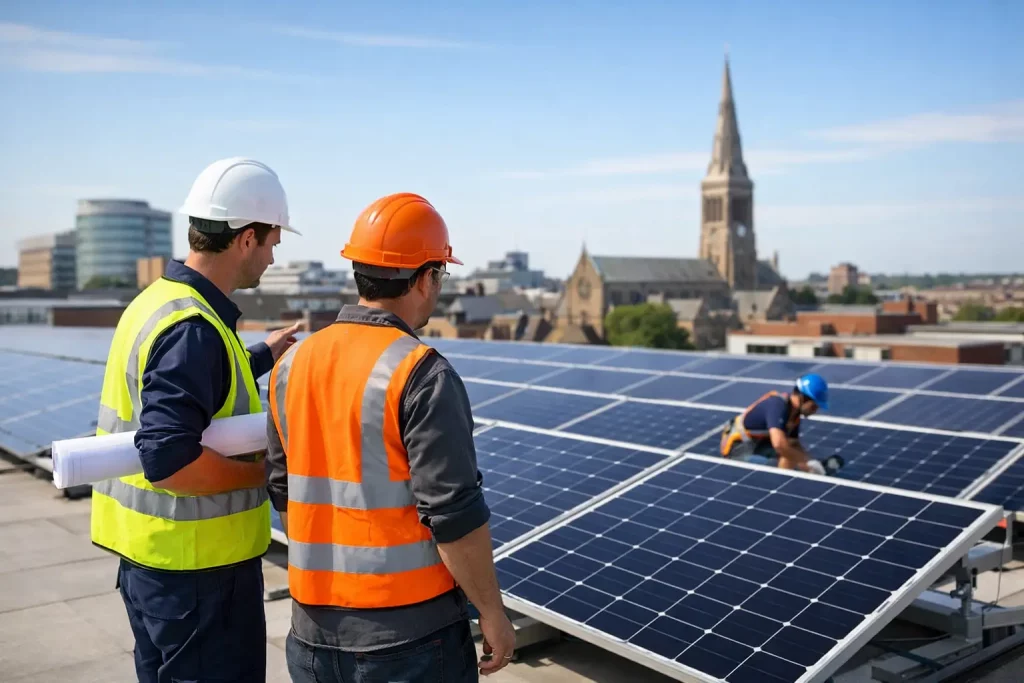
For Leicester businesses facing high daytime electricity use, solar is no longer a distant sustainability target. A commercial solar installer Leicester property owners can rely on should start with the numbers: how much power your site uses, when it uses it, and how much of that demand can be covered by generation from your own roof or land.
The right system can reduce reliance on grid electricity, lower operating costs and give your business greater control over future energy spend. However, commercial solar is not a one-size-fits-all purchase. The best result comes from a properly designed system that suits the building, the electricity profile and your plans for the site.
Why commercial solar makes sense for Leicester businesses
Most commercial premises use a meaningful proportion of their electricity during the day, when solar panels generate power. Offices, warehouses, factories, retail sites, schools and hospitality venues can all benefit when on-site generation is matched to daytime consumption.
Rather than buying every unit of electricity from the grid, your business uses the solar electricity produced at the property first. This is known as self-consumption, and it is usually where the strongest financial value sits. Any surplus may be exported, subject to the agreed export arrangements and your local grid connection capacity.
For many businesses, solar also supports wider commercial objectives. Lower carbon emissions can strengthen tender responses, help meet internal environmental targets and demonstrate practical action to customers, investors and staff. It is a visible improvement to the property that keeps working long after installation day.
The exact saving depends on your electricity tariff, operating hours, roof size, shading and the proportion of solar power used on site. A business that runs mainly during daylight hours may see a different return from one that operates overnight. This is why a credible proposal should be based on your actual consumption data, not a generic promise.
What a commercial solar installer in Leicester should assess
A quality installation begins before panels are selected. Your installer should assess the property and the commercial case together, so the proposed system is practical to install and financially sensible to run.
Your electricity demand
Half-hourly data, smart meter information and electricity bills help identify when your business consumes the most power. This matters because an oversized array may export more electricity than you want, while an undersized system can leave valuable roof space unused.
Your future demand matters too. If you are adding electric vehicle charging, expanding production, installing air conditioning or moving from fossil-fuel heating to heat pumps, electricity use could increase. Designing with these changes in mind can avoid unnecessary alterations later.
Roof condition, orientation and structure
Commercial roofs vary widely. Flat roofs may allow panels to be set at an appropriate angle, while pitched roofs can offer excellent generation depending on orientation and available area. East and west-facing arrays can also be valuable because they spread generation across the morning and afternoon, which may better match business activity.
A survey should consider roof age, waterproofing, access, shading from nearby buildings or trees, drainage routes and structural capacity. If a roof is close to needing replacement, it may be more cost-effective to complete that work before installing solar. Addressing this early protects the investment and reduces the risk of future disruption.
Grid connection and permissions
Commercial systems need to comply with network requirements. Depending on the system size and local network capacity, the Distribution Network Operator may need to approve the connection before work starts. This process can influence the final export capacity, programme and system design.
Planning requirements also need checking. Many installations can proceed without a full planning application, but this depends on the building, location and the scope of the project. Listed buildings, conservation areas and ground-mounted arrays require particular care. A professional installer will explain the likely route rather than making assumptions.
Panels are only part of the solution
A commercial solar installation includes much more than modules on a roof. Inverters convert the solar electricity for use in your building, mounting systems secure the array, monitoring tracks output and safety equipment protects the installation. The quality of these components, and how they work together, affects long-term performance.
Battery storage can be a worthwhile addition where a business uses significant energy outside solar production hours, has variable demand or wants to retain more of the electricity it generates. Stored electricity can be used later in the day, during the evening or at times when grid electricity is more expensive.
Batteries are not automatically the right choice for every site. If your business consumes most solar production as it is generated, the additional cost may not provide the same return. Conversely, a site with evening demand, EV charging or a requirement to manage peak usage may find storage particularly useful. The decision should be modelled against your energy profile rather than added as an afterthought.
For sites planning EV chargers, air source heat pumps or air conditioning, an integrated approach is especially valuable. Solar generation, battery storage and electrified building services can be designed to support each other, helping you make better use of on-site energy while improving comfort and reducing dependence on conventional fuels.
Choosing the right commercial solar installer Leicester businesses need
Price matters, but the lowest quotation is not always the lowest-cost solution over the life of the system. Compare the proposed system size, annual generation estimate, equipment specification, warranties, installation method and assumptions behind the savings forecast.
Look for an installer that can clearly explain the design in plain English. You should understand how many panels are proposed, where they will be installed, what power output is expected and how the system will interact with your existing electrical supply. If an estimate appears unusually high, ask whether it assumes you will use most of the generated electricity on site or whether it relies heavily on export payments.
Certification is also important. An MCS-certified installation provides reassurance that the system is designed and installed to recognised standards, and it may be needed for access to relevant export arrangements. Your installer should provide the paperwork, commissioning information and handover documents required to operate and maintain the system with confidence.
Airtech Renewables takes a practical, whole-property approach to low-carbon technology. For commercial customers, that means considering solar panels alongside battery storage, EV charging, heating, cooling and ventilation requirements where appropriate, rather than treating every system as a separate project.
The installation process should minimise disruption
A well-planned commercial installation usually follows a clear route: site survey, system design, quotation, grid and planning checks where required, installation, commissioning and handover. The physical installation period depends on the size and complexity of the array, as well as access and weather conditions.
For occupied premises, the programme should account for staff, customers, deliveries and normal trading activity. Roof access, working areas, cable routes and any temporary power arrangements should be agreed before work begins. Good communication is not an extra – it is essential for keeping a project safe and avoiding disruption to the business.
Once commissioned, monitoring gives you visibility of system generation and can help identify any unexpected changes in performance. Solar panels have no moving parts and generally need limited maintenance, but periodic checks and sensible cleaning arrangements may be appropriate depending on the site environment. Dust, bird activity and nearby industrial processes can affect some roofs more than others.
Focus on value, not headline system size
The most effective commercial solar system is not necessarily the largest one that will fit on your roof. It is the one that delivers a strong balance of generation, on-site use, cost, building suitability and future flexibility.
Start with a detailed conversation about how your business uses energy now and where it is heading. A properly specified solar system can turn available roof space into a long-term business asset, providing cleaner electricity and more predictable energy costs for years to come.