
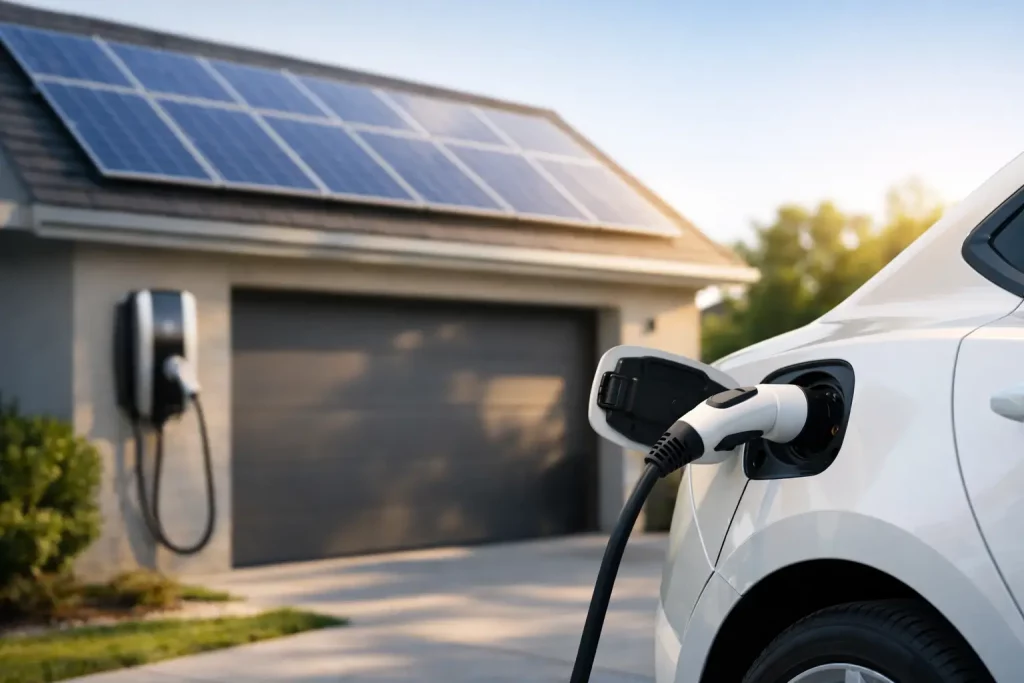
A home EV charger can become one of the most useful ways to use your solar generation. But can solar power charge electric cars reliably in the UK, where sunshine varies by season and many drivers need to charge after work? Yes – with the right system, solar can reduce the cost and carbon impact of everyday driving. The key is to design the panels, charger and optional battery storage around how much you drive and when your car is usually at home.
Can solar power charge electric cars directly?
Yes. Solar panels generate electricity whenever there is sufficient daylight, and that electricity can supply appliances in your property, including an EV charger. A smart charger can detect spare solar generation and direct it into your car rather than exporting it to the grid.
In practice, your car is connected to both your home electrical supply and the grid. If your panels are producing more power than the house needs, the charger can use that surplus. If clouds pass over, household demand rises, or the car needs more power than the panels can provide, it can draw the difference from the grid. You do not have to choose between a solar-only charge and no charge at all.
This is why a professionally installed smart EV charger matters. Rather than simply charging at full power whenever it is plugged in, it can prioritise solar surplus, schedule charging for cheaper overnight tariffs, and help you avoid importing expensive electricity during peak periods.
How much solar power does an electric car need?
The answer depends on the vehicle, annual mileage, driving efficiency and the size of your solar array. A typical electric car might use around 0.25 to 0.35 kWh per mile. For a driver covering 8,000 miles a year, that is roughly 2,000 to 2,800 kWh of electricity annually.
A well-positioned 4 kW domestic solar PV system in the UK may generate around 3,400 kWh per year, although roof direction, shading, location and panel specification all affect the final figure. On an annual basis, that could be enough energy to cover a significant share of both household electricity use and EV charging. It will not all be available at the precise moment you plug in, however.
A useful way to think about it is that solar does not need to provide every mile for the system to deliver value. Each unit of solar electricity used to charge your vehicle is a unit you do not need to buy from the grid. For households with daytime charging opportunities, such as remote workers, retirees, landlords with daytime access to a communal charger, or businesses with vehicles on site, solar matching can be particularly effective.
A simple charging example
If your EV needs 30 kWh for a useful top-up and your panels are generating 3 kW of spare power, the car could receive that solar energy over about 10 hours. This is realistic on a bright summer day if the vehicle is at home, but less likely during a short winter day.
A standard 7 kW home charger will charge much faster when using grid power, but your solar array may only be producing a portion of that figure. Smart solar charging allows the charge rate to vary with generation, so you use available renewable electricity without needing to monitor the system all day.
Solar charging in summer and winter
Solar panels work throughout the year, including on bright overcast days, but output is not consistent. Summer generation is often far higher than winter generation because daylight hours are longer and the sun sits higher in the sky. This means solar EV charging is most straightforward from spring to early autumn.
Winter should not put you off installing solar. The panels will still contribute to your property’s electricity demand and can still add energy to your car on suitable days. The practical approach is to combine solar charging with tariff-based charging. Your smart charger can take free surplus solar when it is available, then charge overnight at a lower off-peak rate when necessary.
That combination gives you control rather than dependence on one source. You are using your own renewable generation first, while retaining the convenience of a fully charged vehicle whenever you need it.
Do you need a solar battery to charge an EV?
No. A battery is not essential for solar EV charging. If your car is at home during the day, a smart charger can send spare generation straight from the panels to the vehicle. This is often the most efficient route because electricity is used as it is produced.
Battery storage can still be a valuable addition, especially where daytime generation does not match household routines. A home battery can hold some solar electricity for use later in the evening, reducing grid imports after the sun has gone down. It can also store lower-cost off-peak electricity for household use, depending on your tariff and system controls.
There is an important trade-off. Most domestic batteries are smaller than an EV battery. A 10 kWh home battery can make a meaningful difference to evening energy use, but it will not usually provide a full EV charge. For many homes, it makes more financial sense to use solar directly in the car where possible and reserve battery capacity for evening household demand.
The best choice depends on your load profile. A household that is empty during daylight hours may benefit from battery storage and scheduled off-peak EV charging. A household with a car on the drive and someone working from home may get excellent results from solar-diversion charging alone.
Choosing the right solar and EV charging setup
A joined-up design prevents common frustrations, such as installing a charger that cannot respond to surplus solar or fitting too few panels to make a noticeable difference to annual electricity use. Your installer should look at your roof, consumer unit, vehicle, mileage and typical home occupancy before recommending equipment.
Four decisions have the biggest effect on performance:
- Solar array size: More panel capacity can generate more electricity for your home and vehicle, subject to roof space, orientation and budget.
- Charger capability: Choose a smart EV charger with solar-surplus charging and scheduling functions, rather than a basic charge point.
- Battery storage: Consider it where you have substantial unused daytime generation or high evening electricity demand.
- Energy tariff: A suitable time-of-use tariff can reduce the cost of grid charging when solar output is low.
For commercial properties, the calculation is similar but the opportunity can be greater. Offices, workshops and depots often use electricity during daylight hours, while fleet vehicles may be parked for long periods. Solar panels, battery storage and managed EV charging can work together to lower operating costs and support cleaner business travel.
What affects the savings from solar EV charging?
The value of solar charging is based on the electricity you avoid buying. Import electricity usually costs more than the rate paid for exported solar, so using generation in your home or vehicle can improve the return from your panels.
Your results will vary. A south-facing, unshaded roof generally produces more than a heavily shaded or north-facing roof. A driver who can charge during the day will typically use more direct solar than someone who returns home at 6 pm and needs the car ready by 7 am. Your household demand also matters: if a heat pump, cooking appliances or air conditioning are already using the available solar, there may be less surplus for the vehicle at that moment.
Smart controls help manage these competing demands. They can be set to protect a minimum charge level for your car, prioritise solar when conditions allow, and switch to scheduled grid charging when a journey is planned. This keeps the system practical. Saving money is useful, but it should never mean worrying whether the car will be ready in the morning.
Is solar EV charging worth it in the UK?
For many homeowners and businesses, yes. The strongest case is where you already plan to install solar, own an EV or expect to buy one, and can use at least some energy during daylight hours. Adding a compatible charger creates another productive use for the electricity generated on your roof.
It is less about chasing a perfect off-grid solution and more about reducing your reliance on bought electricity over time. A quality solar PV system can supply your property for decades, while a smart charger helps turn each sunny period into lower-cost miles.
Airtech Renewables can design integrated solar, battery storage and EV charging systems that suit the way your property actually uses energy. A properly sized system gives you a clearer route to lower bills, cleaner driving and a home that is ready for the next stage of electrification.
The most useful next step is to look at your annual mileage, electricity bills and daytime routine together. Those three details will show whether direct solar charging, battery storage, off-peak charging, or a combination of all three will give your property the best return.