
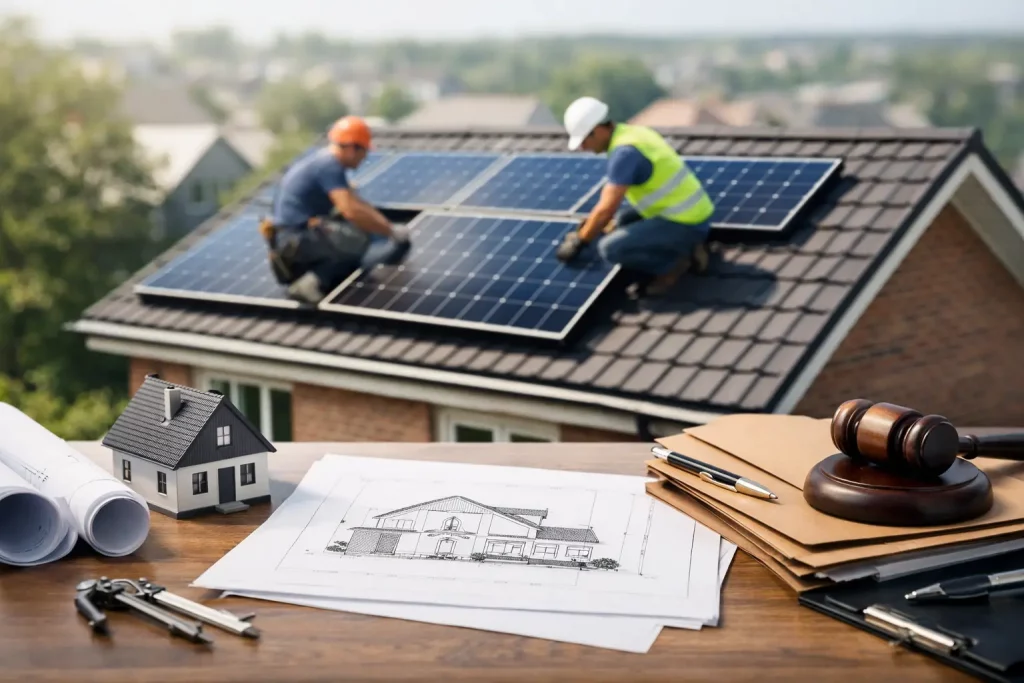
You have found the right roof, worked out the likely savings, and you are ready to cut your electricity bills. Then the obvious question comes up: do solar panels need planning permission? In most cases across the UK, domestic solar panels do not need full planning permission, but there are important exceptions. If your property is listed, in a conservation area, or the system design sits outside normal permitted development rules, you may need approval before installation starts.
That is the short answer. The more useful answer is that planning depends on your property, the type of solar system, and how visible or prominent the installation will be. Getting this right early helps you avoid delays, redesign costs, and problems when the system is already booked in.
Do solar panels need planning permission in the UK?
For many homes, solar panels fall under permitted development. That means you can usually install them without submitting a full planning application, as long as the system meets certain conditions. These rules exist to make low-carbon upgrades easier while still protecting the appearance of buildings and local areas.
In practice, standard roof-mounted solar on a typical house is often straightforward. Panels should not project excessively from the roof surface, and the installation should be designed to minimise its visual impact as far as practical. Installers also need to make sure the system is sited sensibly and safely, rather than simply fitting as many panels as possible wherever there is space.
This is why the answer is rarely just yes or no. A well-designed domestic array on a pitched roof may be covered by permitted development, while a larger or more unusual layout on the same street may need planning consent.
When planning permission is more likely to be needed
Some properties need extra care from the start. Listed buildings are the clearest example. If your home is listed, you are much more likely to need listed building consent, and possibly planning permission as well. The reason is simple: any work that affects the character of a listed building is closely controlled.
Conservation areas can also change the picture. Solar panels are not automatically banned in these locations, but their position matters more. If panels are going on a roof slope that faces a highway and is visible from the road, restrictions may apply. A rear roof slope or less visible elevation may be easier, but it still needs checking.
Flat roofs are another area where assumptions can cause trouble. Panels on flat roofs may still be possible under permitted development, but the height of the system above the roof can become an issue. If the frame lifts the panels too far, it may fall outside the allowed limits and trigger the need for planning.
Ground-mounted solar can also require a closer look. Small domestic ground arrays may be permitted in some cases, but size, location, distance from boundaries, and overall impact all matter. For businesses or larger properties, planning considerations become more detailed quite quickly.
The difference between planning permission and other approvals
One reason this topic causes confusion is that planning permission is only one part of the process. Even if you do not need planning approval, the installation still has to comply with building regulations and relevant electrical standards.
That means structural suitability, fire safety considerations, and correct electrical installation all still matter. If you are connecting a solar PV system to the grid, there may also be notification or approval requirements with the Distribution Network Operator, depending on system size and specification.
For landlords, developers, and commercial property owners, there can also be lease terms, freeholder permissions, or site-specific restrictions to consider. So while planning is often the headline question, it is not the only box to tick.
Roof-mounted solar panels and permitted development rules
Most homeowners asking do solar panels need planning permission are talking about roof-mounted systems. These are usually the simplest route because they use the existing roofline and have limited impact on the surrounding site.
To remain within permitted development, panels generally need to sit close to the roof surface and not protrude more than the allowed amount. The system should also be positioned to reduce its effect on the external appearance of the building and the local area. If equipment is no longer needed, it should be removed as soon as reasonably practical.
Those points may sound technical, but they are really about common sense. A tidy, well-integrated installation is far less likely to raise planning issues than a bulky, poorly placed system. This is one reason in-roof solar can appeal to some property owners. Because the panels are integrated into the roof rather than mounted above it, the finish can look neater and less visually intrusive.
That said, appearance alone does not decide whether permission is needed. The property type and location still matter, and local interpretation can vary.
Listed buildings, conservation areas and sensitive sites
If your property falls into a protected category, it is worth slowing down and checking the detail before you commit. Listed buildings usually involve the highest level of scrutiny. Even a high-quality solar installation that saves money and reduces carbon emissions can still need formal consent because of the impact on the building’s character.
In conservation areas, local authorities often take a more balanced view. They may support renewable upgrades, but they will still consider visibility, design, and whether the panels alter the appearance of the street scene. In some cases, moving panels to a rear elevation, using an in-roof system, or adjusting the layout can make approval more likely or remove the need for a full application.
This is where practical design matters. The best solar result is not always the one with the highest panel count. Sometimes a slightly smaller system in the right location is the better long-term option because it keeps the project compliant and avoids delays.
Commercial solar and larger installations
For commercial buildings, farms, and multi-unit developments, planning can be more complex. The larger the system, the more likely it is that planners will look closely at visual impact, structural implications, neighbouring properties, and site use.
Industrial units and agricultural buildings may still benefit from permitted development rights in some circumstances, but these rights are not identical across every building type. Roof size, panel projection, site designation, and whether the property sits in a protected area can all affect the answer.
If you are a business owner or developer, early planning checks are especially worthwhile. They help protect project timelines and budget, which matters just as much as the energy savings.
How to check before you install
The safest approach is to confirm the planning position before work begins, rather than relying on general advice online. Start with the basics: identify whether your property is listed, whether it sits in a conservation area, and what kind of roof or site the panels will be installed on.
After that, review the proposed system layout properly. Panel position, mounting method, height, and visibility all matter. A professional installer should be able to flag likely issues early and help shape a compliant design rather than leaving you to sort it out after the survey.
If there is any doubt, your local planning authority can confirm whether permission is likely to be required. In more sensitive cases, it can be worth applying for a lawful development certificate. This is not always mandatory, but it gives formal confirmation that the work is lawful, which can be useful if you later sell or refinance the property.
What homeowners should keep in mind
The main thing is not to let planning worries put you off solar altogether. For a large number of UK homes, the process is more straightforward than people expect. The issue is not that solar is difficult to approve. It is that some buildings and locations need a more careful approach.
A good installer will not treat planning as an afterthought. They will look at the roof, the property type, and the local setting before recommending a system. That protects the investment and helps make sure the panels deliver what you want them to deliver: lower bills, better energy independence, and a more future-ready property.
If you are asking do solar panels need planning permission, the honest answer is usually no, but sometimes yes, and the difference comes down to the detail. Getting that detail checked early is often the fastest route to a smooth installation and savings you can actually start using.