
A layer of dust, pollen or bird droppings can look worrying from the ground, particularly after a dry spell. But do solar panels need cleaning every year to keep saving you money? For most UK properties, the answer is no – not as a routine job. Rainfall usually removes ordinary loose dirt, and unnecessary cleaning can introduce avoidable safety and damage risks.
The right approach is to monitor performance, inspect the array from a safe position and clean only when there is clear evidence that soiling is affecting output. This protects the return on your solar investment without paying for work that is unlikely to make a meaningful difference.
Do solar panels need cleaning as part of maintenance?
Solar panels have no moving parts and require very little day-to-day maintenance. Their smooth, angled glass surface is designed to shed rainwater and much of the dust that settles on it. In the British climate, regular rain does a useful amount of natural cleaning.
For a typical pitched-roof system in Leicester or elsewhere in the UK, light dirt is rarely enough to justify professional cleaning. A panel that looks slightly dusty may still be generating close to its expected output. More importantly, generation naturally changes with the season, cloud cover and daylight hours, so a lower figure on your monitoring app does not automatically mean the panels are dirty.
Cleaning is more likely to be worthwhile where contamination is visible and persistent. This includes heavy bird droppings, thick pollen, leaves trapped around the lower edge of the array, soot from nearby industrial activity, or dust from agricultural and construction work. Panels installed at a shallow angle may also retain dirt more readily than steeper roof-mounted systems.
Start with performance, not appearance
Before arranging a clean, look at what the system is producing over time. Compare recent generation with the same period last year where possible, allowing for differences in weather. Your inverter or monitoring platform may also flag a fault, communication issue or reduced generation that needs investigation.
A sudden, significant drop in output is not usually caused by a light film of dust. It could indicate shading from new tree growth, a tripped isolator, an inverter fault, a damaged cable or a problem affecting one section of the array. Cleaning will not solve these issues, and delaying a proper inspection could cost more in lost generation.
Seasonal variation matters too. A clear day in June will produce substantially more electricity than a grey day in December, even with spotless panels. Looking at longer-term patterns gives a far more reliable picture than judging output from one day or one app reading.
Situations where cleaning can help
There are cases where a careful clean is sensible. Bird droppings are a common example because they can form an opaque patch that rain may not shift quickly. If droppings repeatedly build up in one area, it may be worth considering whether a nearby perch, chimney or nesting site is contributing to the problem.
Rural properties can experience heavier pollen or dust during certain times of year. Homes near busy roads, building sites or industrial premises may also see more residue. In these locations, a safe inspection after an extended dry period can help establish whether there is a genuine build-up rather than ordinary surface dust.
Leaves should be dealt with differently. A few leaves on a panel are not normally a concern, but debris lodged beneath or around panels can block drainage and create a damp area. This is best checked as part of professional roof and system maintenance rather than by climbing up with a brush.
Why frequent cleaning is not always the best choice
It is easy to assume that cleaner glass always means considerably more electricity. In practice, the gain from cleaning a normally soiled UK domestic array is often modest. The cost, access requirements and risk involved may outweigh the small improvement in output.
Roof access is the main concern. Working at height without the right equipment can lead to serious injury, while walking on roof tiles may crack them or dislodge fittings. Panels themselves must never be stood on, as this can damage the glass, frame or cells beneath the surface.
There is also a risk of using the wrong method. Abrasive pads, harsh detergents, strong chemicals and pressure washers can scratch the glass, affect seals or force water into areas it should not reach. Cleaning hot panels with cold water can create thermal stress, particularly on a bright summer day.
For these reasons, a company promising dramatic output improvements from frequent panel cleaning should be treated with caution. A good maintenance decision is based on the condition of your installation, not a one-size-fits-all annual contract.
How solar panels should be cleaned safely
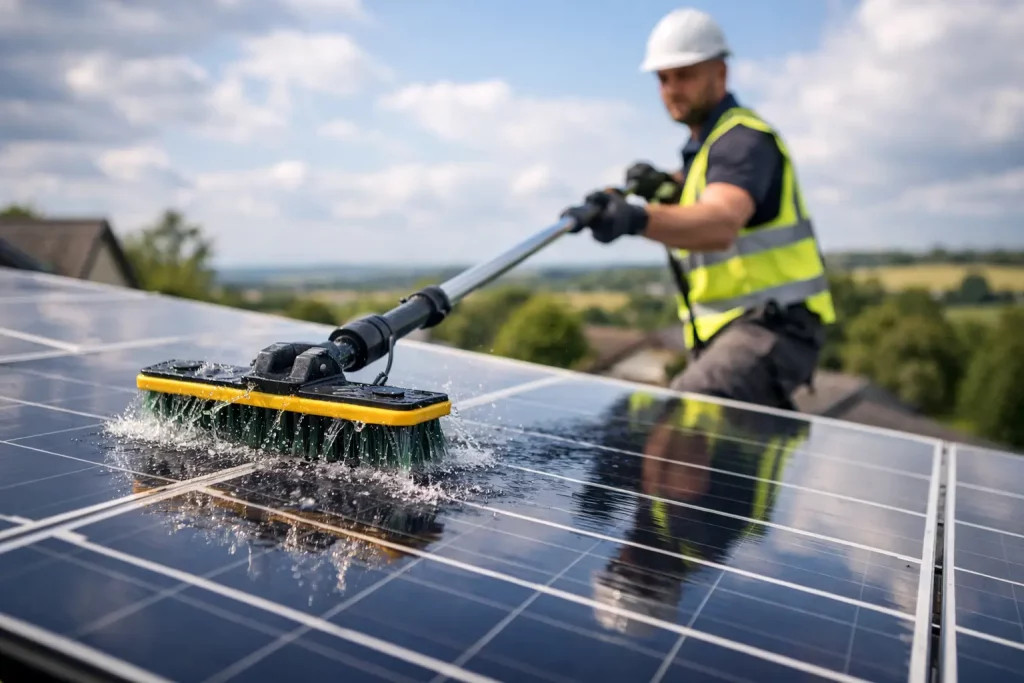
If cleaning is genuinely needed, safety and gentle handling come first. The best option for many households is to use an experienced solar maintenance professional with appropriate working-at-height procedures. They can inspect the panels, mounting system, cabling and roof condition at the same time.
Where panels are safely accessible from ground level, such as a low array on a suitable frame, use clean water and a soft, non-abrasive brush or sponge. Choose a cool, overcast time of day or early morning, when the panels are not hot. Avoid detergents unless the panel manufacturer specifically permits a suitable product, as residue can attract more dirt and some chemicals can affect the surface coating.
Do not use a domestic pressure washer, metal scraper, rough scouring pad or hard-bristled brush. Do not lean ladders against the panels or their frames. If access requires climbing onto a roof, the work should be left to a qualified professional.
What about rainwater, tap water and hard-water marks?
Rainwater is generally sufficient for normal dirt. If you do clean accessible panels, purified or soft water can reduce the chance of mineral spotting, particularly in hard-water areas. However, the bigger priority is avoiding damage and working safely. A few water marks are unlikely to have a noticeable effect on annual generation.
Keep shading and faults under control
For long-term performance, cleaning is only one small part of looking after a solar PV system. Shading often has a greater effect. Trees that have grown since installation, new extensions, chimneys, satellite dishes and neighbouring buildings can all change how much sunlight reaches the array.
Check from ground level whether new shadows are falling across the panels during the middle of the day. Do not remove or cut back trees without considering ownership, local restrictions and nesting seasons. A professional assessment can establish whether shading is materially affecting the system and what practical options are available.
It is also worth checking your monitoring system periodically. If an inverter displays a warning, stops generating, or reports a persistent fault, arrange an inspection rather than assuming panel cleaning is the answer. Batteries, EV chargers and other connected energy equipment should also be considered as part of the wider system, particularly where you are trying to maximise self-consumption and reduce grid imports.
A sensible maintenance plan for UK solar owners
A simple annual visual check is usually enough for most homes and businesses. From a safe position, look for obvious bird droppings, leaf build-up, loose-looking fittings, damage after severe weather and changes in shading. Review generation against previous periods and keep an eye on inverter alerts.
Arrange professional support when there is visible, stubborn soiling, a clear unexplained fall in performance, roof-access concerns or signs of physical damage. This gives you a chance to address the real cause of reduced output rather than spending money on unnecessary work.
Well-designed solar panels are built to work quietly in the background for years. Treat cleaning as a targeted maintenance task, not a compulsory chore, and focus on the measures that make the greatest difference to your electricity savings and system reliability.