
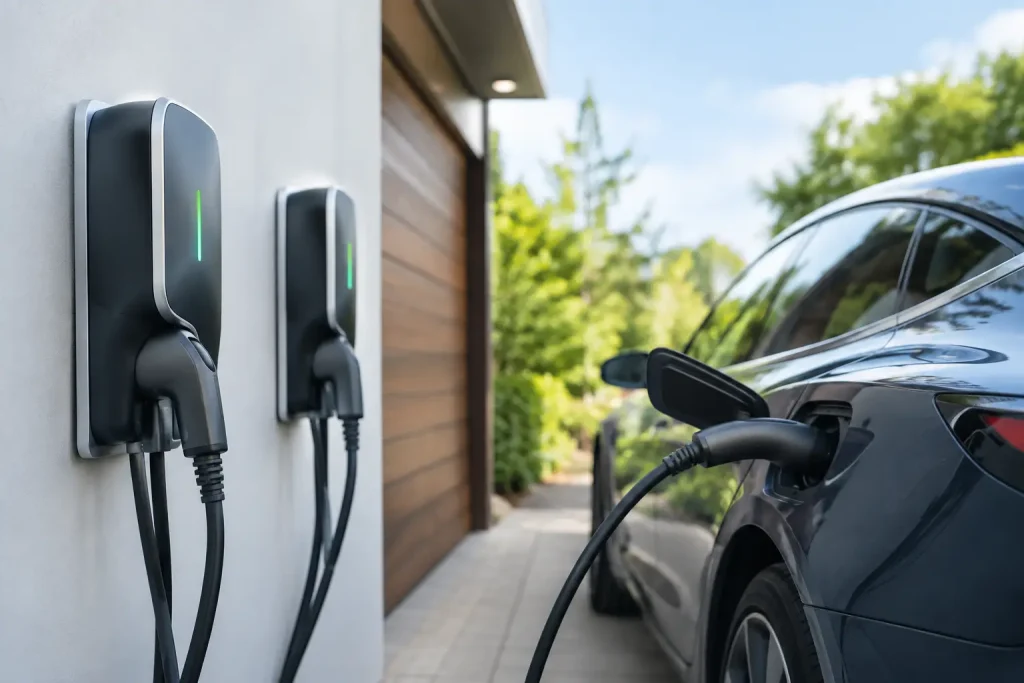
A new electric vehicle charger should make life easier, not create concern every time the oven, heat pump and shower are running. EV charger load balancing manages how much electricity the charger draws in real time, helping homes and businesses charge safely without overloading their existing supply.
For many properties, this can avoid the cost and disruption of upgrading the electrical connection simply to install an EV charger. It is also particularly useful where solar panels, battery storage, electric heating or several vehicles are part of the picture.
What is EV charger load balancing?
Load balancing is a smart charging function that monitors electricity demand at a property and adjusts charging power when necessary. Rather than allowing an EV charger to pull its full rated output regardless of what else is switched on, the system makes sure the total demand stays within a safe limit.
A sensor, often fitted around the incoming supply cable near the consumer unit, measures the electricity being used across the building. If demand rises because appliances and heating systems are operating, the charger automatically reduces its output. Once demand falls, charging power can increase again.
The vehicle still charges, but it does so at a rate that works with the available capacity. For most homeowners charging overnight, this makes little practical difference to daily use. For commercial sites, it can be the difference between adding several charging points and facing a major supply upgrade.
Why electrical capacity matters
Every property has a limit on the amount of electricity it can draw safely. In a typical home, the incoming supply has to serve everything at once: lighting, cooking, washing, hot water, heating, air conditioning and any other electrical equipment. A 7kW home charger is a significant additional load, especially in an all-electric property.
Without load balancing, peak demand can exceed the capacity of the supply or protective equipment. That may lead to tripping, interrupted charging or a recommendation to increase the property’s electrical capacity. An upgrade is sometimes the right solution, but it can involve extra cost, coordination with the Distribution Network Operator and, in some cases, substantial site work.
Load balancing does not create more electricity. What it does is use the capacity already available more intelligently. The charger becomes flexible, reducing demand for a short period when the building needs power elsewhere.
This is useful in homes with air source heat pumps, immersion heaters and induction hobs, where several high-demand systems may overlap during colder months. It is equally valuable for landlords and developers planning charging provision across flats, shared parking areas or new-build homes.
How dynamic load balancing works in practice
Dynamic load balancing is the version most property owners need. It reacts continuously to actual energy use, rather than working to a fixed charging limit.
Imagine a home with a 7kW charger. During the evening, the household may be cooking dinner while a heat pump and hot water cylinder are also running. The load balancing system detects the increased demand and temporarily lowers the charging rate. Later, when demand drops, the charger can return towards full power.
The driver does not need to manually adjust settings each time. The process is automatic, helping to protect the supply while keeping the vehicle ready for the next journey.
Some systems allow installers to set a clear maximum import limit. This setting should be based on the property’s supply capacity, the main fuse arrangement and the expected electrical loads. Correct installation and commissioning are essential. A charger should not be selected on its headline power rating alone.
Static limits versus dynamic control
A static limit simply caps a charger at a chosen output, such as 16 amps. It can be suitable for straightforward installations where future demand is unlikely to change. The downside is that the charger remains restricted even when the property has plenty of spare capacity.
Dynamic control is more flexible. It allows the charger to use available capacity when it is there, then backs off only when necessary. This can deliver faster charging over a typical week without placing avoidable strain on the electrical installation.
EV charger load balancing for solar homes
Solar panels and EV charging are a strong combination. Generating electricity on the roof and using it to charge a vehicle can reduce reliance on grid electricity, particularly when the car is at home during the day.
However, solar generation changes with weather, season and time of day. Load balancing helps manage the other side of the equation: how much power the property is using. When household demand rises, the charger can respond rather than competing with essential loads.
Some smart EV chargers also offer solar charging modes. These can prioritise surplus solar generation, charging the car when the property is producing more electricity than it is using. This is not the same as load balancing, although the two features work well together. Solar charging aims to increase self-consumption, while load balancing protects the supply from excessive demand.
Battery storage adds another consideration. A well-designed system can store lower-cost overnight electricity or surplus solar power for later use, while the EV charger follows the agreed charging plan. The best setup depends on driving patterns, tariff timings, solar generation and whether the vehicle is normally parked at the property during daylight hours.
Multi-charger load balancing for businesses
For a business, adding EV charging can quickly increase electricity demand. A workplace with four 7kW chargers could theoretically require 28kW if every vehicle charges at full rate. A larger car park with 22kW units can require far more.
In reality, not every driver needs maximum power at the same moment. Most workplace vehicles are parked for several hours. Load balancing can share the available power between chargers, adjusting each vehicle’s charging rate as demand across the site changes.
This approach helps businesses provide practical charging for staff, visitors and fleet vehicles without automatically paying for an oversized electrical connection. It can also support phased expansion. A business may begin with a small number of charging points, then add more later while managing demand through intelligent control.
There are trade-offs. If several vehicles arrive with low batteries and all require a rapid turnaround, the available capacity may not be enough. In that case, a supply upgrade, more chargers, different operating schedules or a combination of these measures may be needed. Load balancing is a cost-effective management tool, not a substitute for capacity where high power is genuinely required.
What to consider before installation
The right charging solution begins with a survey of the property and how the vehicle will be used. A good assessment considers the incoming electrical supply, consumer unit condition, cable route, parking location and the likely demand from existing and planned systems.
For households, it is worth considering future changes as well as current use. If you intend to add solar panels, a battery, electric heating or another EV in the next few years, selecting a charger with dynamic load balancing can prevent a simple installation becoming restrictive later.
For commercial premises, the assessment should include operating hours, fleet requirements, staff parking patterns and any equipment that creates high daytime loads. A warehouse, office, retail site and small industrial unit will each have different demand profiles. Charging should be designed around the way the site actually operates, not around a one-size-fits-all charger specification.
Questions worth asking your installer
Ask whether the charger will monitor the whole-property load, whether it can be integrated with solar generation and whether it can manage multiple chargers if requirements grow. You should also ask how the system responds during periods of high demand, what charging data is available and whether the equipment is suitable for your existing electrical supply.
Quality matters here. The charger, protective devices, cabling and control equipment must work together correctly. A cheaper unit without the right smart controls may look attractive initially, but it can limit future flexibility or lead to additional work later.
A practical route to lower-cost charging
EV charging works best when it is planned as part of the property’s wider energy system. For a home, that may mean pairing a smart charger with solar panels, battery storage and an off-peak electricity tariff. For a business, it may mean allocating available power across staff charging while protecting essential operations.
Airtech Renewables can assess the electrical demand of your home or business and recommend an EV charging setup that fits the way you use energy. The aim is straightforward: safe charging, sensible installation costs and a system ready for the next stage of your low-carbon plans.
Before choosing a charger, look beyond its maximum kW rating. A properly specified load balancing system can help you make better use of the supply you already have, while keeping the option open for cleaner energy technologies in the future.