
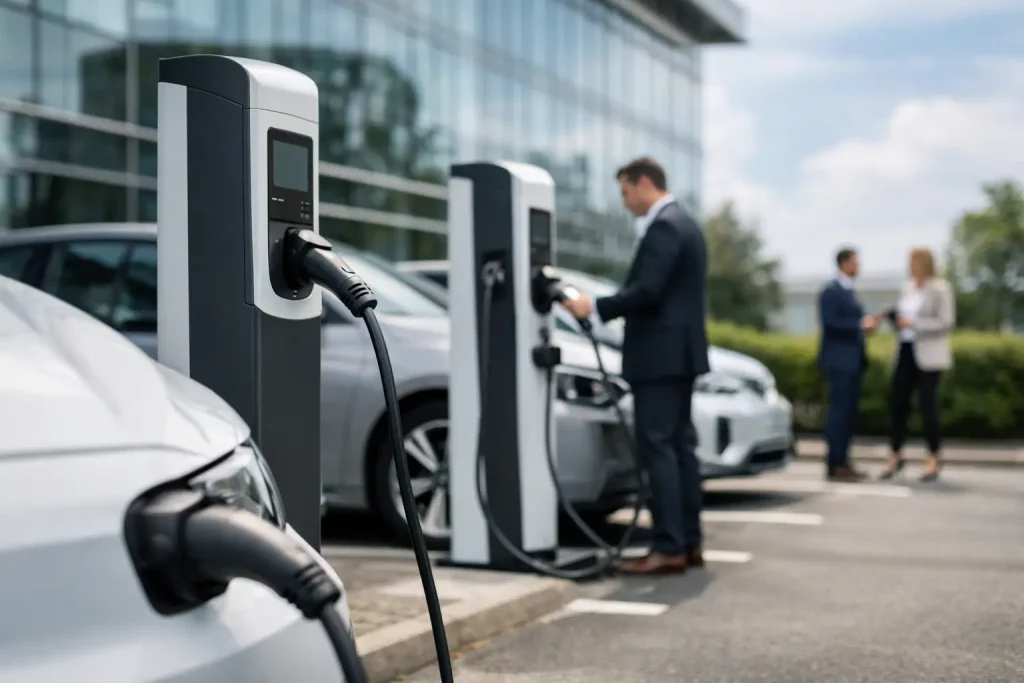
A company car park can do more than hold vehicles between meetings. With the right charging setup, it can lower fleet running costs, support staff, attract customers and make better use of electricity generated on site. This guide to commercial EV charging explains what UK businesses need to consider before installing charge points – without overcomplicating the decision.
Commercial charging is not one-size-fits-all. A depot with electric vans has very different requirements from a hotel, office, retail site or residential development. The best system is one that matches how long vehicles are parked, how much power the building can provide and what the business wants to achieve.
Why commercial EV charging is becoming a practical investment
Electric vehicles are now a realistic choice for company cars, delivery fleets and private drivers. Employers are responding to staff demand for workplace charging, while customer-facing businesses are using chargers to make their sites more convenient. For landlords and developers, providing charging infrastructure can also help make a property more appealing and future-ready.
The financial case often begins with fuel. Charging an electric vehicle can cost considerably less per mile than petrol or diesel, particularly where businesses can charge during lower-cost electricity periods or use solar generation. It also gives fleet managers greater control over energy use and makes expenses easier to track.
There is a commercial benefit beyond charging revenue, too. A charger at a workplace can support employee retention. At a destination site, it can encourage drivers to stay longer. For fleets, it can reduce reliance on public charging and the downtime that comes with it. The return on investment depends on usage, electricity prices and installation costs, but a well-planned system delivers value in several ways.
Start with how vehicles use the site
Before selecting a charger, look at the vehicles and their parking patterns. This is the decision that prevents unnecessary spend on high-power equipment that drivers cannot use, or a lower-output installation that soon becomes a bottleneck.
An office car park may suit standard AC chargers where employees park for six to eight hours. A hotel or leisure venue often has similar dwell times, making charging at a moderate rate a sensible fit. A courier depot, taxi operation or site with vehicles turning around quickly may need faster charging, potentially including DC units, to keep operations moving.
It is also worth separating present demand from likely future demand. You may have five electric company vehicles now but expect that number to rise as leases change. Installing the right cabling, distribution equipment and spare capacity at the outset can make future expansion far less disruptive than starting again in a few years.
Workplace, fleet and public-facing charging
Workplace charging is usually about convenience and employee benefit. Access can be restricted to authorised users, with drivers paying nothing, paying a set tariff or reimbursing electricity used. Smart charging gives the business a clearer view of consumption and helps avoid charging every vehicle at full power at the same time.
Fleet charging is more operational. Vehicles must be ready when needed, so charging schedules should reflect routes, shift times and battery sizes. Overnight charging is often the most cost-effective approach for vans and company cars, particularly when paired with off-peak tariffs.
Public or customer charging places more emphasis on access, payment and visibility. Businesses need a system that allows visitors to start a charge easily while still protecting the site from excessive electricity costs. The right back-office software can set tariffs, issue usage reports and help manage multiple chargers from one place.
Choosing the right commercial EV charger
Most commercial sites use AC chargers rated at 7kW, 11kW or 22kW. These are practical for longer stays and are usually more affordable to install than rapid DC equipment. However, the charging speed available to each vehicle can be limited by the vehicle itself, as well as the site’s electrical supply.
DC rapid and ultra-rapid chargers provide much faster charging, but they require substantially more power and a larger upfront budget. They are better suited to sites where drivers need a quick top-up rather than an all-day charge. For many workplaces, spending the same budget on several intelligently managed AC chargers is a better outcome than installing one high-power unit.
A commercial charger should be durable, safe and easy to manage. Look for features that serve the way your business operates: access control, RFID cards or app-based use, load balancing, energy monitoring, payment options and remote fault reporting. For publicly accessible installations, clear signage, parking bay management and accessible placement should also be considered from the beginning.
Load balancing protects your building supply
One of the most useful features in commercial EV charging is dynamic load balancing. This monitors the building’s electricity demand and adjusts charging output so that chargers use available capacity without overloading the supply.
For example, an office may have lower electrical demand overnight but higher demand during the working day. Smart controls can charge vehicles more quickly when the building load drops, then reduce output if heating, cooling or other equipment needs more power. This can avoid costly upgrades while allowing several vehicles to charge reliably.
Assessing electrical capacity and installation needs
A professional site survey is essential. The installer will assess the existing electrical supply, consumer units, cable routes, parking layout, groundworks and where chargers can be positioned safely. This identifies whether the site has enough capacity for the planned chargers or whether upgrades are required.
The shortest route between the distribution board and the parking bays is not always the best route. Cable runs need to be protected, practical to maintain and suitable for the environment. Car parks may need trenching, bollards or wheel stops to protect equipment. Indoors, chargers should be located where cables do not create trip hazards or obstruct access.
Where a larger electricity connection is needed, the timescale can be longer and costs can rise. That does not automatically mean the project is unsuitable. Smart load management, phased installation and solar battery storage can sometimes reduce the scale of the upgrade required. The right answer depends on site conditions and future demand.
Make solar power part of the plan
For businesses with suitable roof space, solar panels can make commercial charging more cost-effective. Solar generation can contribute to vehicle charging during daylight hours, reducing the amount of electricity bought from the grid. This is particularly attractive for offices, retail premises and visitor destinations where vehicles are parked during the day.
Solar does not mean every charge will be entirely free or that charging stops when the weather changes. Generation varies by season, weather and time of day. The benefit comes from using more of the electricity your business generates on site, rather than exporting it for a lower value.
Battery storage can add further flexibility by storing surplus solar electricity and releasing it later when demand rises. It may not be right for every site, but it can help businesses manage peak demand, increase solar self-consumption and support charging at more valuable times. An integrated design is usually more effective than treating solar, batteries and chargers as separate projects.
Set a clear charging policy
The technology is only part of the solution. Businesses should decide who can charge, when they can charge and how electricity costs will be handled. A clear policy avoids confusion as adoption grows.
Staff charging may be offered as a free benefit, billed at cost or charged at a rate that contributes towards running and maintenance. Fleet drivers may need priority during certain hours. Customer chargers may need time limits to prevent bays being occupied after charging has finished. These rules should be simple, communicated clearly and supported by the charger management system.
Usage data is valuable here. It shows which chargers are busiest, how much electricity is being used and whether additional points are genuinely needed. It can also help a business identify avoidable costs, such as vehicles left connected long after they are fully charged.
Plan for growth without paying for unused capacity
A sensible commercial EV charging project balances immediate needs with future flexibility. Installing ten chargers where only two will be used may tie up unnecessary capital. Equally, installing a single charger with no route to expansion can create problems as more drivers switch to electric.
A phased approach is often the practical choice. Prepare infrastructure for a larger number of chargers, install the units needed now and add more as demand is proven. This keeps the initial investment focused while protecting the site from expensive rework later.
Airtech Renewables can assess your site, electrical demand and wider energy plans to create a charging solution that works with your property rather than against it. When chargers, solar generation and battery storage are planned together, your business has a stronger foundation for lower-cost travel and cleaner operations.