
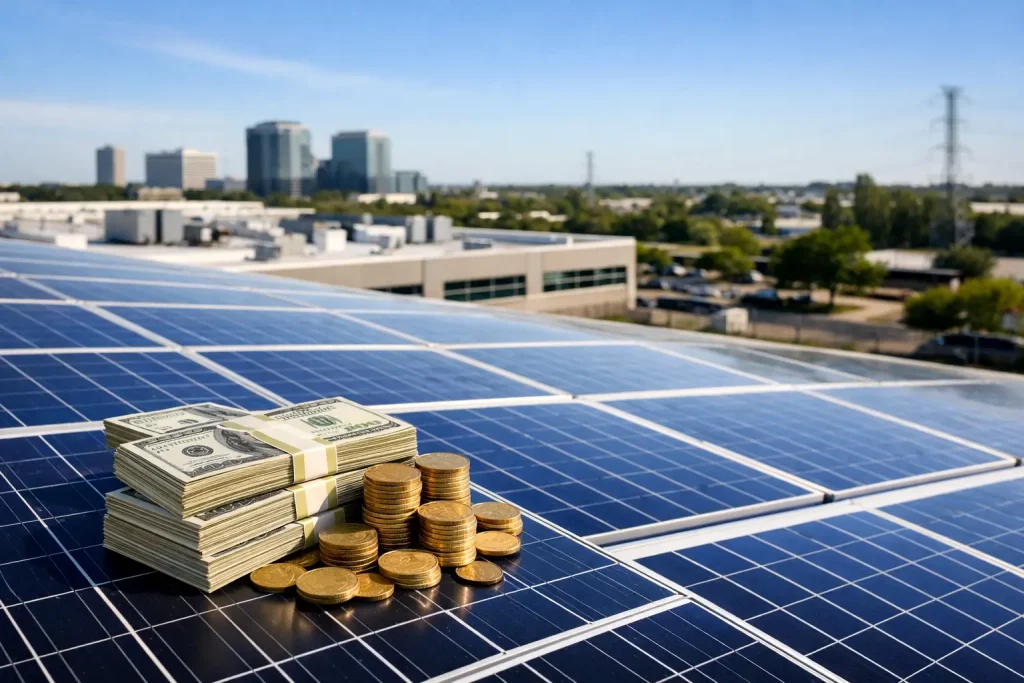
If your business uses most of its electricity during the day, you are likely paying peak-rate prices for power that could be generated on your own roof. That is why commercial solar panel savings are now a serious cost-control measure for warehouses, offices, schools, farms and retail premises across the UK.
The appeal is simple. Solar panels help reduce your dependence on grid electricity, protect your business from energy price volatility and lower your carbon footprint at the same time. For many commercial properties, the numbers are strong because daytime demand lines up well with daytime generation.
That said, savings are never one-size-fits-all. The value of a system depends on how your site uses electricity, how much roof space is available, what you currently pay for power and whether battery storage is part of the design. A good installation is not about fitting the most panels possible. It is about fitting the right system for how your building actually runs.
How commercial solar panel savings are created
Commercial solar works by generating electricity on site so your business buys less from the grid. Every unit of solar power you use directly is a unit you do not need to import at your usual tariff. That is where the clearest saving comes from.
There can also be value in exporting unused electricity, but for most businesses the biggest benefit comes from self-consumption. In plain terms, the more of your own solar power you use while it is being generated, the better the return tends to be.
This is why commercial buildings often perform well. Offices, factories, workshops, hospitality venues and agricultural sites usually have predictable daytime loads. Lighting, equipment, refrigeration, ventilation and IT systems all consume power during the same hours that panels are producing it.
What affects your savings most
The first factor is your electricity usage pattern. Two businesses with similar roofs can see very different returns depending on when they use energy. A site that is busiest from morning to late afternoon will usually save more than one that is largely inactive during daylight hours.
The second factor is the price you pay for imported electricity. If your current business tariff is high, the financial case for solar becomes stronger. With commercial energy prices remaining a concern for many organisations, reducing grid dependence can create meaningful long-term savings.
Roof suitability also matters. South-facing roofs often perform best, but east-west layouts can still be very effective, especially if they better match business demand across the working day. Shading, roof condition and available space all influence output and system design.
System size is another key point. A larger installation may generate more power, but bigger is not always better if much of that energy is exported at a lower rate than the cost of importing electricity. The strongest commercial solar panel savings usually come from a system sized around real usage rather than headline capacity.
Typical buildings that benefit from commercial solar
Commercial solar is not limited to large industrial units. A wide range of properties can benefit if they have suitable roof space and enough daytime electricity demand.
Offices can use solar to offset lighting, air conditioning, computers and general power use. Retail premises often have a steady daytime demand profile, particularly where refrigeration, displays and HVAC systems are involved. Warehouses and distribution sites can benefit from large roof areas, while farms often have strong daytime demand from machinery, cooling, pumping or processing equipment.
Schools, care settings and community buildings can also see good returns. In these cases, the value is not only lower operating costs but more budget certainty over time.
Battery storage and its role in savings
Battery storage can improve solar performance, but it is not automatically the right choice for every commercial site. Its role is to store excess electricity generated during the day so it can be used later, rather than exported straight away.
For businesses with early evening demand, or operations that continue after solar generation drops, batteries can increase self-consumption and reduce imports further. This can strengthen savings, especially if grid electricity is expensive at certain times.
However, batteries add upfront cost. On some sites, the best return comes from solar panels alone. On others, battery storage makes the system far more useful. It depends on your usage profile, your budget and whether flexibility or resilience matters as much as payback.
Payback periods and long-term value
Most business owners want to know the same thing early on – how long before the system pays for itself? There is no fixed answer, but commercial solar typically works as a medium- to long-term investment rather than a quick win.
Payback depends on installation cost, electricity prices, system output, maintenance requirements and how much generated electricity you use on site. When those factors line up well, the returns can be very attractive because the system continues generating savings long after the initial payback period has passed.
It is also worth looking beyond simple payback. Solar can improve budgeting by making part of your electricity supply more predictable. That stability can be just as valuable as the raw savings figure, particularly for businesses managing tight margins or multiple sites.
Why installation quality matters to commercial solar panel savings
A lower quote is not always the better deal if the design is poor, the equipment is unreliable or the installation fails to account for how your building operates. Commercial solar needs to be designed around your property and your energy use, not treated as a generic package.
Panel placement, inverter specification, cable routes, roof loading, access and future maintenance all affect performance. So does compliance. Working with a properly accredited installer helps give you confidence that the system meets current standards and is built to deliver safely over the long term.
This is where experience matters. A provider that understands both generation and wider building energy systems can often spot opportunities that a single-product installer may miss. If your site also uses air conditioning, EV charging, heat pumps or battery storage, a joined-up approach can improve overall efficiency.
Common assumptions that deserve a closer look
One common assumption is that a business needs a perfect south-facing roof to make solar worthwhile. In reality, many commercial roofs with east-west orientation still perform well and may spread generation more evenly across the day.
Another is that solar only suits owner-occupied premises. While ownership often makes the decision simpler, some leased sites can still work if landlord permissions and lease terms are favourable. It is worth checking rather than assuming the option is closed.
There is also a view that solar savings are only meaningful for very large businesses. That is not the case. Small and medium-sized firms can benefit too, particularly where energy costs are a growing pressure and roof space is available.
Getting a realistic view of your potential savings
The best starting point is your electricity data. Half-hourly usage figures, bills and site operating hours help build a much clearer picture of likely savings than rough averages ever will. This is especially important for commercial projects, where energy demand can vary widely by season, shift pattern and equipment use.
A proper assessment should look at annual consumption, daytime load, roof layout and future changes in demand. If you are planning EV chargers, a building extension or new heating and cooling systems, those changes should be considered now rather than after the panels are installed.
A realistic proposal should also be clear about assumptions. If the predicted return depends on very high self-consumption or export values, ask how those figures were reached. Good advice should be straightforward, not overcomplicated.
Commercial solar panel savings as part of a wider energy strategy
The strongest results often come when solar is part of a broader efficiency plan. If your building wastes energy through poor heating control, ageing cooling equipment or outdated ventilation, solar will still help, but it may not deliver the full value it could.
For many businesses, the smart move is to look at generation, storage and energy use together. Solar panels can reduce imported electricity. Battery storage can shift usage. Efficient heating, cooling and ventilation can reduce total demand in the first place. When those systems work together, the savings can be more consistent and easier to scale.
That is why many property owners prefer working with a specialist that can assess the whole picture. Airtech Renewables takes that practical approach, helping customers invest in systems that make financial sense rather than chasing headline specifications.
Commercial solar is not about chasing trends. It is about making your building less expensive to run. If your site has the roof space and the right daytime demand, the savings can be significant, but the best results come from careful design, realistic projections and a system built around the way your business actually uses energy.