
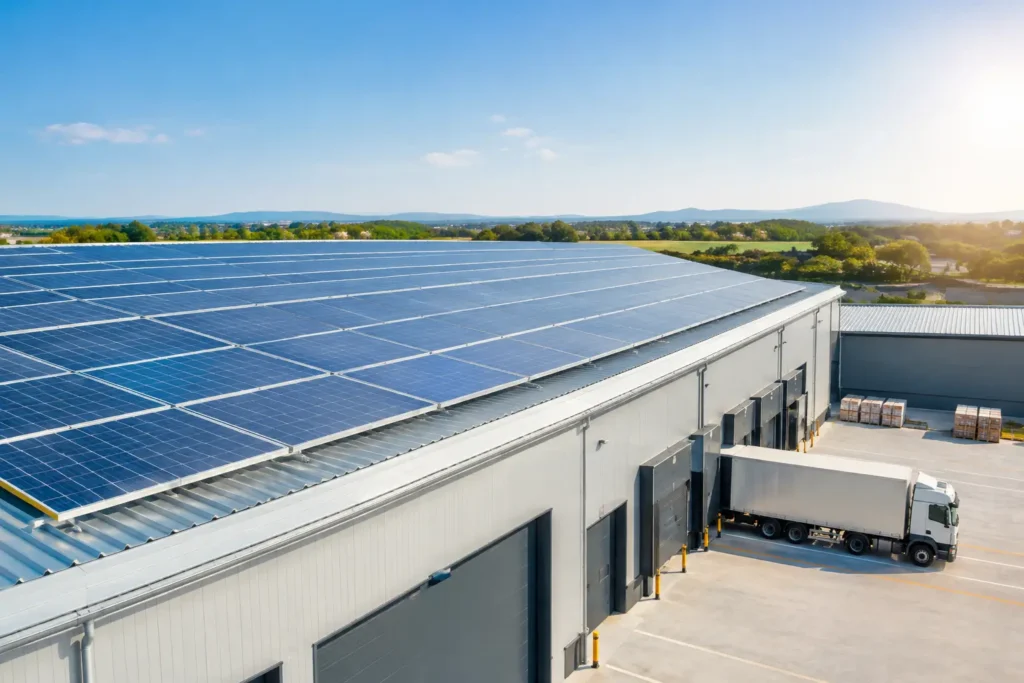
A warehouse roof can be one of the most valuable unused assets on a commercial site. The best warehouse solar results come when a system is designed around how the building actually consumes electricity, rather than simply filling every available square metre with panels. For businesses facing high daytime energy use, rising operating costs and carbon reduction targets, solar can turn roof space into a practical source of long-term savings.
Warehouses are particularly well suited to commercial solar because many operate through daylight hours, when solar panels are producing electricity. Lighting, conveyor systems, refrigeration, office equipment, charging infrastructure and production machinery can all use power generated on site. That means less electricity has to be bought from the grid at commercial rates.
What warehouse solar results can look like
There is no single figure that applies to every warehouse. Results depend on the usable roof area, the building’s electricity profile, panel orientation, shading, system size and the rate paid for imported electricity. However, a well-designed installation can make a meaningful reduction to daytime grid demand and provide a predictable source of lower-cost electricity for decades.
The most valuable result is usually self-consumption. This is the proportion of solar electricity used by the business at the point it is generated. A busy distribution centre that runs throughout the day may use a large share of its generation immediately. A warehouse with lower daytime demand may export more power, which can still create income but often delivers less value than avoiding imported electricity.
For this reason, system size should be based on more than roof capacity. Oversizing a system may increase generation, but it can also increase exported electricity and extend the payback period. The right approach is to assess half-hourly consumption data where available, identify the daytime load and match generation to the building’s operational pattern.
Reduced electricity costs
For many commercial property owners, lower electricity bills are the main driver. Solar panels generate electricity on site, reducing the amount purchased from an energy supplier while the system is producing. The saving per kilowatt-hour depends on the business tariff and the amount of solar power used directly.
A warehouse with consistent daytime demand can achieve stronger returns than a site that is largely inactive during working hours. Refrigerated warehouses, manufacturing sites, logistics facilities and units with electric vehicle charging may have particularly good consumption profiles. Businesses should also remember that savings can change as grid prices change, while solar generation remains available from the completed system.
Better control over future costs
Solar does not remove the need for grid electricity. Warehouses still need imported power overnight, during low-light periods and whenever demand exceeds solar output. It does, however, reduce exposure to a portion of future electricity price rises.
This matters when budgeting for a multi-year lease, managing a large portfolio or planning expansion. A solar installation gives the business a known generating asset on site. That can make energy costs more manageable and support a clearer long-term operating plan.
Lower carbon emissions and stronger reporting
Generating more renewable electricity on site helps reduce a warehouse’s reliance on grid power. For companies working towards environmental targets, supplier requirements or ESG reporting, this can be a clear and measurable improvement.
The carbon benefit should be presented honestly. Solar output varies by season and weather, and the overall reduction depends on how much electricity is displaced. Even so, a properly monitored system provides generation data that can support internal reporting and demonstrate progress to customers, investors and supply-chain partners.
The factors that shape commercial solar performance
A large roof is a major advantage, but it is only the starting point. Before a system is specified, the roof structure, electrical infrastructure and business operations all need careful consideration.
Roof condition and usable space
Not every square metre can carry panels. Rooflights, smoke vents, plant equipment, access routes, drainage points and required safety clearances reduce the usable area. The roof’s age, covering and structural capacity also matter. Installing solar shortly before a roof replacement can create unnecessary future cost, as panels may need to be removed and reinstalled.
A detailed survey helps establish whether the roof is suitable and whether remedial work should be completed first. This is especially important for older industrial buildings, where asbestos-containing materials or limited load capacity may need specialist attention.
Orientation, pitch and shading
South-facing panels generally produce the highest annual output per panel, but east-west layouts can be a strong choice for warehouses. They spread generation more evenly across the morning and afternoon, which may better match a business’s electricity use.
Shading from neighbouring buildings, trees, roof plant or raised sections of the warehouse can reduce output. Modern system design can limit the effect of partial shading, but it should never be ignored at the survey stage. Accurate design is more valuable than optimistic generation estimates.
Grid connection and export limits
Commercial systems need to work safely with the local electricity network. Depending on the proposed capacity, the Distribution Network Operator may need to approve the connection or set an export limit. This can affect the size of the system, the need for export control equipment and the project timescale.
Grid constraints do not automatically prevent a warehouse solar project. They simply need to be addressed early. In some cases, designing around on-site demand, using battery storage or applying for a larger connection can provide a practical route forward.
The role of battery storage
Battery storage can improve warehouse solar results where the business has surplus generation during the day and useful demand later on. It stores electricity that would otherwise be exported, allowing it to be used in the evening, overnight or during higher-cost tariff periods.
That does not mean a battery is right for every site. Commercial batteries add capital cost, and their value depends on the pattern of use, export rates, tariff structure and operational priorities. They are often most effective when combined with a clear energy strategy, such as overnight vehicle charging, refrigeration loads or peak demand management.
How to measure results after installation
The project should not end when the panels are commissioned. Monitoring is essential for confirming that the system is generating as expected and for identifying faults quickly. A commercial solar system should give the business visibility of generation, consumption, export and, where fitted, battery performance.
The figures worth reviewing include total solar generation, the percentage used on site, grid import reduction, exported electricity and financial savings against the relevant tariff. Comparing performance month by month is more useful than judging a system on a single sunny week or a poor winter month.
Seasonality is normal in the UK. Generation will be far higher in late spring and summer than in December and January. A realistic annual forecast should account for this variation, while recognising that actual output will move with weather conditions and changes in site demand.
Maintenance requirements are generally low, but they should not be overlooked. Periodic inspections, monitoring checks and safe access arrangements help protect performance over the life of the installation. If the warehouse roof or electrical systems change, the solar system should be considered as part of that work.
Choosing a warehouse solar system that works commercially
The strongest solar projects start with the business case, not a generic panel count. A professional proposal should consider roof suitability, electricity consumption, available grid capacity, expected self-consumption and the practical requirements of the site. It should also set out realistic generation and savings assumptions in plain language.
For businesses seeking recognised standards and confidence in their installation, using an experienced, appropriately certified installer matters. Airtech Renewables can bring solar panels, battery storage, EV charging and other complementary low-carbon technologies together, helping commercial customers create a more joined-up energy plan rather than treating each upgrade in isolation.
A warehouse may have the roof space to generate significant renewable power, but the best outcome comes from using that power intelligently. Start with your electricity data, assess the building properly and choose a system sized for the way your operation runs. That is how solar becomes a working asset, not simply a set of panels on the roof.