
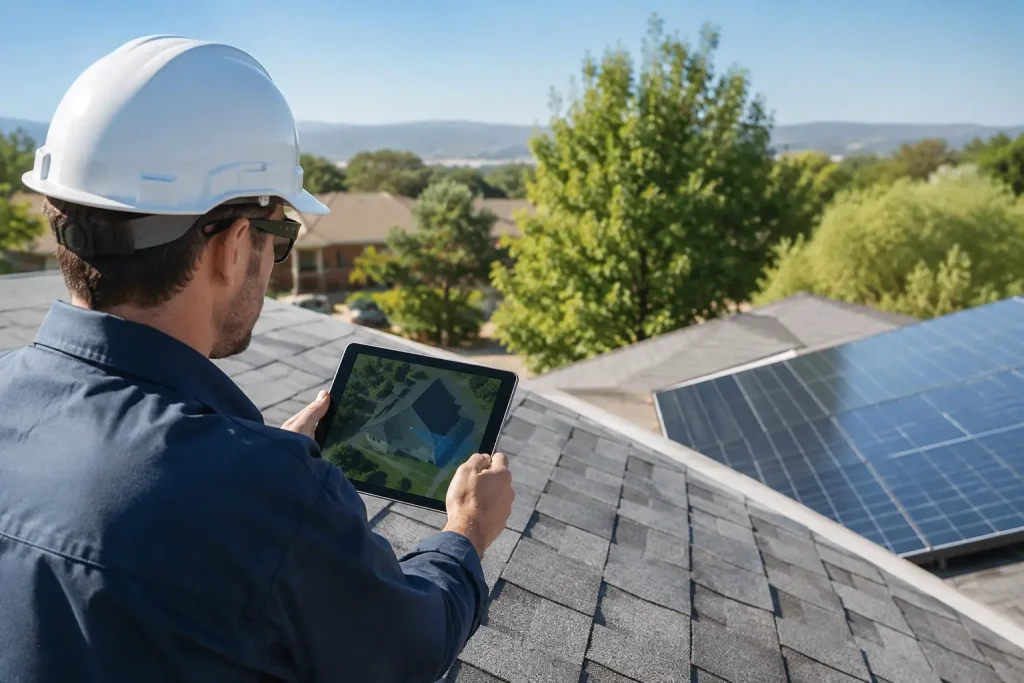
A solar roof can look clear from the pavement yet lose a meaningful share of its generation to a chimney, neighbouring tree or nearby building. Assessing roof shading accurately before installation is therefore one of the most valuable parts of designing a solar PV system. It helps set realistic savings expectations, identify the best roof areas and avoid paying for panels that will spend too much of the day under shade.
For homes and businesses across the UK, the question is not simply whether a roof receives sunshine. The real question is how much usable sunlight reaches each part of the roof over a full year. That difference affects panel positioning, system size, inverter selection and whether battery storage will add greater value.
Why roof shading changes solar performance
Solar panels work best when every panel in a connected group receives similar levels of light. Even partial shade can reduce output more than many property owners expect, particularly where panels are connected in a conventional string. A shaded panel can limit the performance of other panels in that string.
The source of shade matters. A tall chimney may cast a narrow moving shadow for a few hours, while a mature tree can create irregular, dappled shade throughout the day. A neighbouring property may have little effect in summer but block valuable low winter sun, when household electricity demand is often higher.
Shading does not automatically mean solar is unsuitable. Many properties with some shade can still achieve excellent results. It means the system needs to be designed around the roof rather than fitted to a standard layout. A sound assessment allows projected generation and financial returns to reflect the property as it really is.
What needs to be checked on site
An accurate survey considers more than the roof’s direction and pitch. The installer should examine every feature that may affect sunlight now and in future.
Obstacles on and around the roof
Chimneys, dormer windows, soil pipes, skylights, aerials and satellite dishes all create localised shade. Their impact changes as the sun moves from east to west and sits at different heights through the seasons. Panels can often be positioned around these features, but the resulting layout must still make practical and financial sense.
External obstacles need equal attention. Trees, neighbouring homes, commercial buildings, telegraph poles and roof-mounted equipment can all restrict solar access. A survey should look beyond the immediate boundary, especially in built-up areas where the sun is low for much of the winter.
Seasonal variation
A roof that appears unshaded on a bright June afternoon may not perform in the same way in November. In winter, the sun travels lower across the sky, making shadows longer. Deciduous trees may lose their leaves, but their branches can still obstruct direct light. Evergreen trees remain a year-round consideration.
This is why a quick visual check on one day cannot provide the whole picture. Good solar design models the sun’s path across the year and estimates the likely annual effect of obstructions.
Roof orientation and usable area
South-facing roofs usually provide the highest annual generation in the UK, but east-west layouts can also be highly effective. They spread production more evenly between morning and afternoon, which may suit households using power before and after work or businesses with daytime demand.
The most productive roof plane is not always the best place for every panel. If the lower section of a south-facing roof is regularly shaded while an east-facing roof is clear, a split layout may produce more usable energy overall. The available space also needs to allow safe clearances around roof edges and access points.
How professional solar shading assessment works
A proper assessment combines physical inspection with solar modelling. Measurements are taken for the roof dimensions, pitch, orientation and height of relevant obstructions. These details are then used to estimate the solar resource available to each proposed panel position.
Specialist survey tools can capture the horizon and identify obstructions at different angles around the property. Satellite imagery and roof modelling may assist with early estimates, but they are not a substitute for a site survey where shade is uncertain or the roof has several complex features.
The aim is to calculate an annual shading loss rather than make a vague judgement that a roof is ‘mostly sunny’. This gives a clearer generation forecast in kilowatt-hours and makes it easier to compare system options fairly. A well-presented proposal should explain the assumptions behind its predicted output, including the impact of orientation, pitch and shade.
For MCS-standard solar installations, accurate performance estimates are particularly important. They support a design that is appropriate for the property and give the customer a more dependable basis for assessing payback.
Assessing roof shading accurately: choosing the right equipment
Once shading has been identified, the design can be adjusted. In some cases, moving panels away from an obstruction is enough. In others, using module-level power electronics can help reduce the effect of intermittent or uneven shade.
Optimisers allow individual panels to operate more independently within a string, while microinverters convert power at each panel. Both can be useful on roofs where chimneys, trees or roof shapes create varying conditions. They are not essential for every installation, and they add cost, so the choice should be based on the expected shading loss and the value of recovered generation.
Panel layout also matters. Keeping heavily shaded panels separate from consistently clear panels may improve performance. A system designed over two roof aspects may use separate strings or suitable inverter inputs so that one roof plane does not unnecessarily affect another.
Battery storage does not remove a shading problem, but it can improve how you use the solar electricity that is generated. It stores surplus production for later use, reducing electricity imported from the grid during the evening. The right battery size depends on generation, household or business consumption patterns, and the level of surplus likely after shading has been considered.
Can trees be managed?
Trees are one of the most common causes of solar shading and one of the most sensitive. Pruning may improve generation, but it must be carried out responsibly and within planning, ownership and wildlife protection requirements. A tree in a neighbour’s garden cannot simply be treated as an installation issue.
It is also wise not to base a solar forecast on a hoped-for pruning arrangement unless it has been agreed and completed. Trees grow, and a clear roofline can change over a few years. Where a tree is likely to remain, the system should be designed for the conditions that are realistically expected.
There can be a trade-off here. Removing or heavily cutting back greenery solely to gain a small amount of additional solar output may not be the best environmental or practical choice. Often, better layout and equipment selection provide a more balanced solution.
Questions to ask before approving a solar design
A reliable installer should be able to explain where shade occurs, how it has been allowed for and what it means for the proposed system. Ask whether the forecast accounts for chimneys, nearby buildings and seasonal sun angles. If optimisers or microinverters are recommended, ask what specific shading issue they are intended to address.
It is also worth asking whether every proposed panel earns its place. The largest possible array is not always the best-value array if several panels are severely shaded. A slightly smaller system on the clearest available roof areas can offer stronger returns and a cleaner installation.
For landlords and commercial property managers, assess usage as well as generation. A building with substantial daytime demand may benefit from an east-west array that produces power across working hours, even if its peak output is lower than a south-facing design. The best answer depends on the property, its shading profile and how electricity is used.
A careful solar survey turns shading from an unwelcome surprise into a design decision. With clear measurements, realistic generation figures and the right equipment, a shaded roof can still become a worthwhile source of lower-cost, lower-carbon electricity. Airtech Renewables can help property owners assess the opportunities on their roof and build a system around practical savings rather than guesswork.