
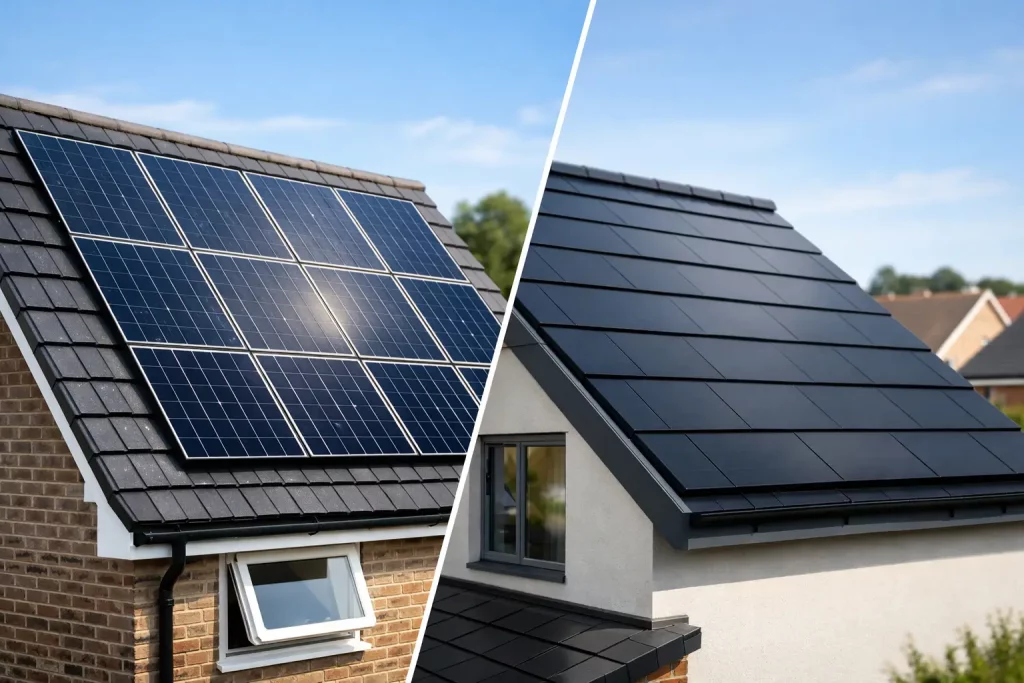
A south-facing roof can become one of the most valuable parts of your property, but the right solar solution is not always the most obvious one. When comparing solar panels vs solar tiles, the key question is whether you prioritise maximum generation and value, or a more integrated roof appearance. Both can reduce reliance on grid electricity, but they suit different budgets, roof types and project plans.
Solar Panels vs Solar Tiles: The Key Difference
Conventional solar panels are larger photovoltaic modules fitted on top of an existing roof covering. They are usually mounted on rails above the tiles or slates, creating a small gap that allows air to circulate beneath them. This is the most widely installed domestic solar option in the UK because it is proven, efficient and cost-effective.
Solar tiles, sometimes called solar roof tiles, are smaller photovoltaic units designed to look and function more like part of the roof itself. Rather than sitting clearly above the roofline, they replace sections of the existing roof covering. The finished result can be far more discreet than a standard panel installation.
It is also useful to separate solar tiles from in-roof solar panels. An in-roof system uses full-sized solar modules recessed into the roof structure, replacing a section of tiles. Solar tiles are individual tile-sized generating units. Both create a cleaner roofline than on-roof panels, but they are different products with different installation requirements.
For most homes and commercial properties, standard panels deliver the strongest balance of output and upfront cost. Solar tiles can be an excellent choice where the roof is being built or replaced and appearance is a major deciding factor.
Cost and Value for Money
Cost is often where the choice becomes clearer. On-roof solar panels generally require less specialist roof work, use fewer individual electrical connections and produce more power from a given roof area. That usually makes them the more affordable route to solar generation.
Solar tiles cost more because the installation is more labour-intensive and the products themselves are typically more specialised. A roof may need to be stripped or substantially altered before the system is fitted. If your roof is in good condition and you simply want to reduce your electricity bills, replacing large areas of it to install solar tiles may be difficult to justify financially.
The calculation changes when a new build, extension or complete re-roof is already planned. In that situation, solar tiles can replace part of the roof covering you would have paid for anyway. They still tend to carry a premium, but the gap between the two options may be smaller once roofing work is included.
A good solar decision should look beyond the initial quote. Consider expected generation, how much electricity you use during daylight hours, whether you will add battery storage, and the remaining life of your roof. The lowest installation price is not always the lowest long-term cost, but a system that is oversized for your usage or poorly suited to the roof will not offer the return you want either.
Performance and Available Roof Space
Solar panels are normally more productive per square metre than solar tiles. Their larger cells and simpler layout mean more of the roof can be devoted to generating electricity. This matters on compact roofs, where every usable square metre counts.
Solar tiles may require a larger area to achieve the same system size. Their individual format can also mean more inactive space around edges, vents, roof windows and awkward roof shapes. For a property with limited south, south-east or south-west facing space, conventional panels will often provide the better energy yield.
That does not mean solar tiles perform poorly. A well-designed solar tile installation can generate useful clean electricity for decades. However, customers should be realistic about what the roof can produce. Shading from chimneys, trees, neighbouring buildings and dormers affects both solutions. A detailed site survey is essential because even a visually attractive installation can underperform if much of the roof is shaded at key times of day.
Orientation matters too, but it is not an automatic deal-breaker. South-facing roofs usually offer the highest annual generation, while east-west arrays can produce electricity more evenly across the morning and afternoon. This can be particularly useful for households that use power before and after work, or businesses with steady daytime demand.
Appearance, Planning and Property Type
Solar tiles are chosen largely for their appearance. They sit closer to the roofline and can be particularly appealing on high-value homes, architect-designed properties and projects where visible panels would compromise the intended finish. If your property has a prominent front roof slope, this can be a genuine benefit rather than a cosmetic extra.
On-roof panels are more visible, but modern all-black panels, neat cable routing and carefully planned layouts can still look smart and purposeful. For many homeowners, the appearance is a reasonable trade-off for a lower-cost system with higher generation potential.
Planning rules should be checked early, especially for listed buildings, homes in conservation areas and properties with specific local restrictions. Permitted development rights may apply in many cases, but they are not universal. Solar tiles are not automatically exempt simply because they are less noticeable. The building’s status, roof design and local authority requirements all matter.
For landlords and developers, practicality often leads the decision. Standard panels are faster to specify, widely understood and easier to scale across multiple properties. Solar tiles may be worth considering where a development is designed around a premium architectural finish or where roof replacement forms part of the construction programme.
Installation, Maintenance and Future Repairs
On-roof solar panels are generally quicker to install because the existing roof remains largely intact. The mounting system is fixed securely to the roof structure, panels are connected, and the system is commissioned. A competent installer will assess roof condition first, as fitting solar to a roof near the end of its life can create avoidable future costs.
Solar tiles need closer coordination between roofing and electrical work. The waterproofing details, flashing, cabling and tile layout must all be planned correctly. This makes installer experience especially important. A poor installation can create issues that affect both energy generation and weather protection.
Maintenance needs are low for both systems. Rain will usually clear normal dirt, although heavy leaf fall, bird mess or persistent grime may reduce performance and occasionally require professional cleaning. Your inverter and monitoring system should make it easier to spot unexpected drops in output.
Repairs can be more straightforward with standard panels because individual modules are easier to access and replace. With solar tiles, locating and replacing a failed unit may involve more roofing work. This does not make solar tiles unreliable, but it is worth discussing warranties, replacement availability and access before committing.
Which Option Is Right for Your Property?
Choose conventional solar panels if your priority is strong generation, quicker installation and the best value from the available roof area. They are usually the sensible choice for existing homes with a sound roof, rental properties, business premises and households focused on reducing purchased electricity as effectively as possible.
Solar tiles may be the better fit if you are replacing the roof anyway, building a new property or placing a high value on a subtle integrated finish. They can make sense where visual impact is the main barrier to adopting solar, provided there is enough roof area and budget to support the system.
In-roof solar panels can offer a useful middle ground. They provide a more streamlined appearance than conventional panels while often delivering stronger output than tile-by-tile products. For a planned re-roof, it is worth comparing all three approaches rather than treating the decision as panels or tiles alone.
Get More From the Electricity You Generate
Whichever roof system you choose, the best results come from using more of your solar electricity on site. A solar battery can store surplus daytime generation for use later in the evening, reducing the amount of electricity bought from the grid. EV charging, hot water controls and heat pump settings can also be planned around solar production.
This is where a whole-property approach pays off. Rather than viewing solar as a standalone installation, consider how it will work alongside your heating, cooling, ventilation and vehicle charging needs. Airtech Renewables can help assess the roof, expected generation and the wider energy systems that will make your investment work harder.
The right choice is the one that fits your roof, your plans and your energy use without stretching the budget for features you do not need. Start with a proper survey, ask for realistic generation estimates, and choose a system you will be pleased to see working on your roof for years to come.