
A south-facing bedroom that stays hot long after sunset, a glazed office that becomes uncomfortable by mid-afternoon, or a retail space losing footfall in a heatwave all create the same problem: the property is not providing reliable comfort. Modern air conditioning units offer far more than a blast of cold air. The right system can cool rooms efficiently in summer, provide useful warmth in milder weather and help create a more usable building all year round.
For homeowners and businesses, the best result comes from matching the system to the property, how the space is used and the energy available. A well-planned installation is quieter, more economical to run and easier to live with than a poorly sized unit chosen on price alone.
Why air conditioning is becoming a practical choice
UK summers are becoming harder to ignore, particularly in newer homes with strong insulation, large areas of glazing and limited natural ventilation. Insulation is essential for retaining warmth in winter, but it can also hold unwanted heat indoors. Bedrooms, loft conversions, garden rooms and top-floor flats often feel the effect first.
Air conditioning provides controlled cooling rather than relying on open windows, portable fans or temporary measures. That matters where security, outside noise, pollen or traffic pollution make open windows impractical. In commercial settings, a comfortable temperature can also support staff productivity, protect equipment and create a better experience for customers.
Most fixed air conditioning systems use heat pump technology. They move heat rather than generating cooling in the traditional sense, which makes them an efficient option when correctly designed. Many systems can reverse their operation to provide heating too. This is particularly useful in a home office, extension or conservatory that needs targeted warmth without heating the entire property.
Choosing air conditioning units for your space
There is no single unit that suits every property. The room size is a starting point, but it is not the whole calculation. Ceiling height, window orientation, insulation levels, number of occupants and heat-producing appliances all affect the cooling requirement. A kitchen with extensive glazing will behave very differently from a shaded bedroom of the same floor area.
An undersized system may run constantly without reaching the desired temperature. An oversized system can cool too quickly, switch on and off more often than necessary and may not manage humidity as effectively. Proper sizing helps deliver steady comfort and more controlled running costs.
Wall-mounted split systems
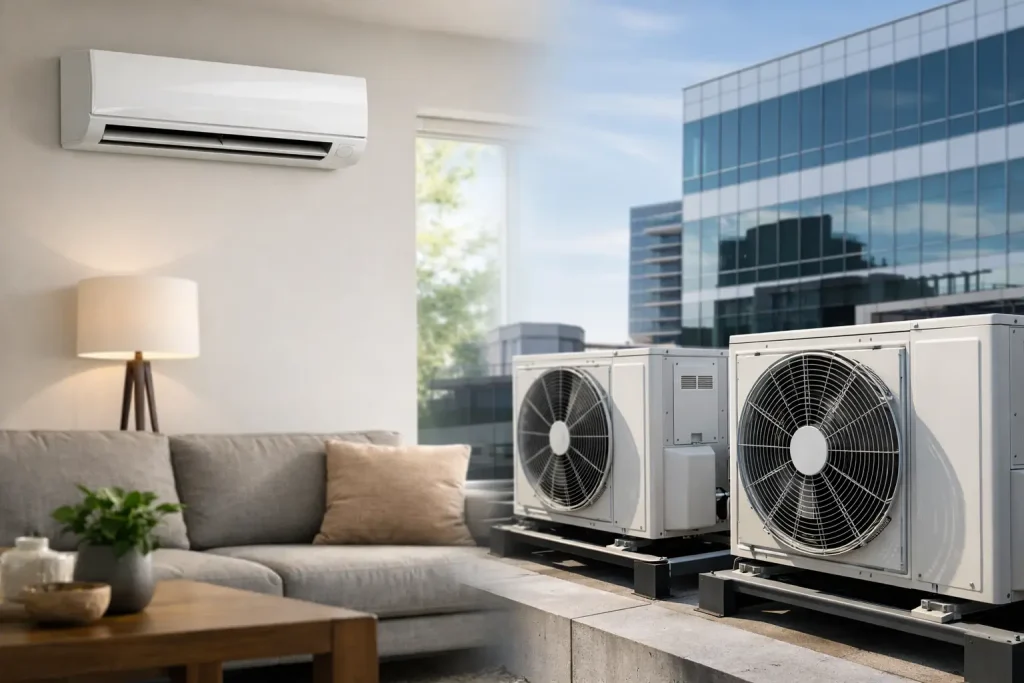
A wall-mounted split system is the most common option for homes and smaller commercial premises. It has an indoor unit that distributes cooled or warmed air and an outdoor unit that releases or collects heat. They are compact, efficient and well suited to individual rooms, including bedrooms, living areas, offices and garden buildings.
The indoor unit is normally positioned high on a wall to allow good air circulation. Careful placement matters. It should direct air across the room rather than straight at a bed, desk or seating area, while also allowing sensible access for cleaning and servicing.
Multi-split systems
A multi-split arrangement connects several indoor units to one outdoor unit. It can be a strong choice for properties that need comfort in more than one room but have limited external wall space. For example, separate units could serve two bedrooms and a home office, each with its own temperature control.
This approach can keep the outside of the property neater than fitting several individual outdoor units. However, it needs thoughtful design because the combined demand of each room and the pipework routes must be considered from the outset.
Ducted and commercial systems
Larger homes, offices, shops and hospitality spaces may benefit from ducted, cassette or ceiling-mounted systems. These options can distribute air more discreetly across wider areas and may suit refurbishment projects or new developments where services can be planned before finishes are installed.
They are not automatically the best answer for every building. Ducted systems require sufficient ceiling or loft space, while commercial premises may need different zones for customer areas, kitchens, server rooms or meeting rooms. A site survey identifies the most practical balance of performance, appearance and installation cost.
Cooling, heating and humidity control
The value of an air conditioning system is not limited to the hottest days of the year. Most modern systems offer heating mode, making them a useful supplementary heat source during spring and autumn. Instead of heating the whole property, you can bring one occupied room up to a comfortable temperature quickly.
It depends on the property and the wider heating system. Air conditioning is not a direct replacement for central heating or an air source heat pump serving radiators and hot water in every situation. Yet it can complement these systems well, especially where rooms have different comfort needs or are used at different times.
Humidity is another overlooked benefit. Warm, humid indoor air can make rooms feel hotter and more uncomfortable, even when the thermometer does not appear extreme. Air conditioning removes moisture as it cools, helping the air feel fresher. It is not a cure for damp caused by leaks, poor insulation or inadequate ventilation, but it can support a more comfortable indoor environment when the underlying building issues have been addressed.
What affects running costs?
Running costs depend on the unit’s efficiency, the electricity tariff, the target temperature and the building itself. A system will work harder in a poorly insulated room with direct sun exposure than in a shaded, well-insulated space. Keeping doors and windows closed while cooling is operating makes a noticeable difference.
Set the temperature sensibly. Trying to make a room very cold on a hot day uses more energy and can feel unpleasant when moving between indoors and outdoors. A moderate setting, adjusted gradually, is usually more comfortable and economical. Features such as inverter compressors, timers, scheduling and occupancy controls also reduce unnecessary operation.
For properties with solar panels, daytime cooling may be especially attractive. Hot, sunny weather is often when solar generation is strongest and cooling demand is highest. Solar power will not always cover the full electricity demand, but using more of the electricity generated on site can improve the value of the wider energy system. Battery storage may add further flexibility depending on household usage patterns and tariff arrangements.
Installation details that should not be overlooked
A quality installation starts with an assessment of the space rather than a quick estimate based only on room dimensions. The installer should consider where indoor and outdoor units will sit, how pipework and condensate drainage will be routed, electrical requirements and how the finished installation will look.
Outdoor unit location is particularly important. It needs clear airflow, a stable base and a position that avoids causing disturbance to neighbours. Noise levels are generally low on modern systems, but placement remains important, especially near boundaries and bedroom windows. Planning requirements can vary by property type, location and the size or position of equipment, so these should be checked before work begins.
Airtech Renewables approaches air conditioning as part of the property’s wider energy plan. Combining cooling with solar generation, battery storage, ventilation or low-carbon heating can make the building more comfortable without treating each system as a separate decision.
Maintenance keeps performance on track
Air conditioning units are straightforward to maintain, but they should not be ignored. Indoor filters collect dust and need regular cleaning to maintain airflow and support good air quality. How often depends on use, pets, cooking, occupants and the environment, although a visual check every few weeks during regular operation is sensible.
Professional servicing helps confirm that the system is operating correctly, drains are clear and key components remain in good condition. Businesses may have additional compliance responsibilities where refrigerant equipment is installed. Acting early on unusual noises, reduced airflow, water drips or weaker cooling can prevent a minor fault becoming a more expensive repair.
Is air conditioning right for your property?
Air conditioning is most valuable where overheating is a recurring issue, a room has a specific use that demands dependable comfort, or a business needs better control over its indoor environment. It may be less urgent in naturally cool properties that are only uncomfortable for a few days each year. In that case, shading, ventilation improvements and insulation measures may be the first priorities.
The strongest investment is rarely the cheapest unit on the day. It is the system that suits the room, is installed with care and works efficiently alongside the rest of the property’s energy setup. When comfort, running costs and long-term performance are considered together, air conditioning can be a practical upgrade that makes every hot spell easier to manage.