
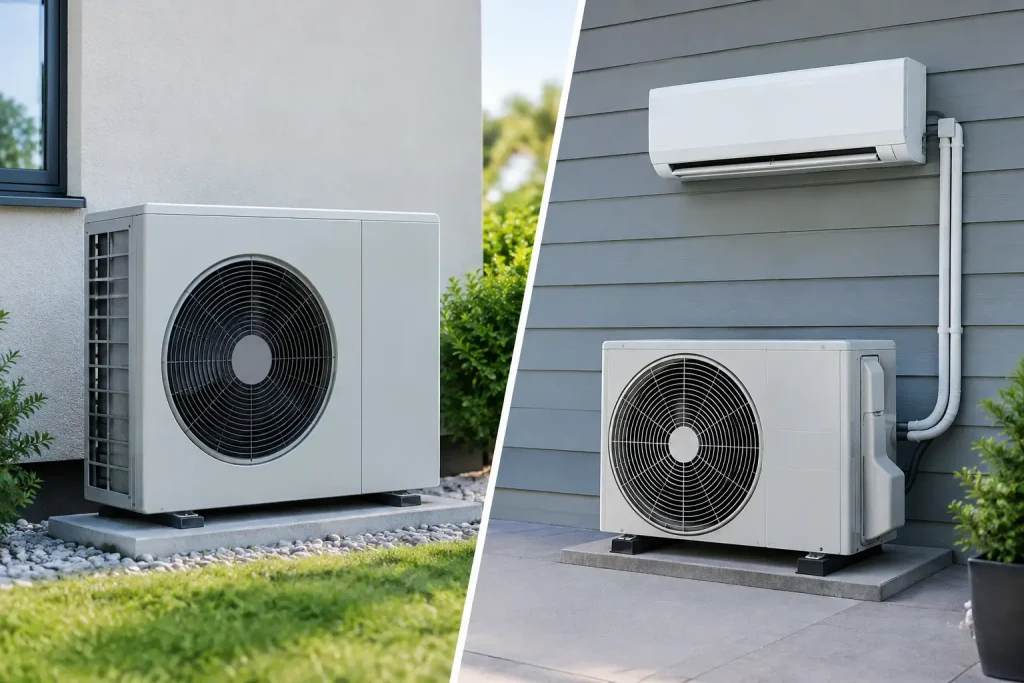
A heat pump may look like one outdoor unit, but the system design behind it can make a real difference to installation, protection against frost and the work required inside your property. When comparing monobloc versus split heat pumps, the right answer is rarely about choosing the “best” technology overall. It is about selecting the heat pump that suits your home, existing heating system and installation conditions.
Both types can provide efficient low-carbon heating and hot water for UK properties. Both can work with radiators, underfloor heating and a suitable hot water cylinder. The key difference is where the refrigerant circuit ends and where the heating water begins.
Monobloc versus split heat pumps: the main difference
A monobloc air source heat pump contains the complete refrigeration circuit within its outdoor unit. It collects heat from the outside air, raises the temperature using refrigerant, then transfers that heat into water. Heated water travels from the outdoor unit into your home through insulated pipework, where it serves the heating system and hot water cylinder.
A split heat pump divides the system between an outdoor unit and an indoor unit, often called a hydrobox. Refrigerant pipework runs between the two units. The heat is transferred to the property’s water system inside the building, rather than outdoors.
This sounds like a small engineering difference, but it changes how the system is installed and protected. A monobloc has water pipework outside, so frost protection is a central part of the design. A split system keeps water indoors until after heat has been transferred, which can reduce the risk of external water pipes freezing.
Neither arrangement automatically delivers lower running costs. A well-designed, correctly sized heat pump will usually matter more to comfort and efficiency than whether it is monobloc or split.
Why monobloc heat pumps are popular
Monobloc units are widely installed in UK homes because the outdoor unit arrives as a sealed refrigeration system. For many properties, this can make installation more straightforward, with the main heating connections made using water pipework rather than refrigerant lines.
The system can be an excellent fit where there is a clear route from the outdoor unit to a utility room, airing cupboard or plant area. It also works particularly well for homeowners replacing a boiler with a modern low-temperature heating system, especially where a hot water cylinder is already planned.
A monobloc installation still needs careful planning. Outdoor heating pipes must be correctly insulated and protected. Depending on the system design, an installer may use glycol antifreeze in the heating circuit, a plate heat exchanger arrangement or other approved frost-protection measures. These details should never be treated as an afterthought. Frozen pipework can cause serious damage and disruption.
Monobloc systems can also require more consideration where the outdoor unit is a long distance from the property. Longer external pipe runs may increase heat loss, add installation complexity and affect the overall cost. In a compact home with a sensible location for the outdoor unit, this is often easy to manage. In a large property, detached outbuilding or awkward extension, it deserves a closer assessment.
When a split heat pump can be the better choice
A split heat pump is often worth considering where the site layout makes external water pipework less practical. Because refrigerant travels between the outdoor and indoor units, the water side of the heating system remains inside the building. This can be useful in exposed locations, properties with long pipe routes or projects where frost protection is a particular concern.
The indoor hydrobox does need space. It is separate from the hot water cylinder, although both are commonly installed in the same utility room or plant cupboard. For homes with limited internal space, this can be a deciding factor. A monobloc arrangement may be neater if the internal equipment needs to be kept to a minimum.
Split systems must be installed by engineers qualified to handle refrigerants. This is normal for experienced heat pump installers, but it means the refrigerant pipework, pressure testing and commissioning need to be completed to the required standards. The installation can be more specialised, and this may affect programme time or cost depending on the property.
A split heat pump is not automatically more efficient than a monobloc. Product specification, flow temperature, controls, insulation levels and emitter sizing have a greater influence on seasonal performance. However, avoiding glycol in certain split-system designs may offer a small efficiency advantage in some circumstances, as glycol can slightly reduce heat-transfer performance. It is one factor among many, not a reason to choose a system in isolation.
Installation factors that matter more than the label
It is easy to focus solely on monobloc or split, but the success of either system depends on a full property survey. A heat pump should be sized from a room-by-room heat loss calculation, not from the size of the boiler it is replacing. Oversizing can increase cost and lead to inefficient cycling, while undersizing may leave rooms struggling on the coldest days.
Your radiators are equally important. Heat pumps work most efficiently at lower water temperatures than traditional gas boilers. Some existing radiators may be large enough, particularly in a well-insulated property, while others may need upgrading. Underfloor heating is naturally well suited to heat pumps because it operates at low flow temperatures across a large surface area.
A suitable hot water cylinder is usually part of the project. Heat pump cylinders have larger internal heat-exchanger coils than many older cylinders, allowing them to transfer heat effectively at lower temperatures. If your current cylinder is ageing or undersized, replacing it can improve both hot water recovery and overall system performance.
The outdoor unit position also needs thought. It needs good airflow, a stable base and enough clearance for servicing. Noise should be assessed in relation to your own windows and neighbouring properties. Planning rules can permit many domestic installations, but permitted development criteria and local circumstances must be checked before work begins.
Cost, running costs and long-term value
The upfront cost of monobloc versus split heat pumps varies by brand, output, installation complexity and the upgrades your home requires. The unit itself is only one part of the investment. Pipework, electrics, cylinder capacity, radiator changes, controls and groundworks can all affect the final figure.
For a straightforward installation, a monobloc may offer a simpler route. For a property with a difficult outdoor-to-indoor pipe run, a split system may justify its added installation requirements. The most affordable choice is the one that achieves reliable performance without compromising on frost protection, pipe insulation or system design.
Running costs depend on the heat pump’s seasonal efficiency and the electricity tariff available to you. A well-designed system can substantially reduce carbon emissions compared with oil, LPG or direct electric heating, and it may reduce heating costs when replacing an inefficient system. Savings against mains gas depend more heavily on insulation, heat demand, electricity prices and how the heat pump is controlled.
Solar panels and battery storage can complement either system by helping a property use more of its own generated electricity. They do not remove the need for good heat pump design, but together they can support lower imported electricity costs and a more future-ready home.
Which heat pump is right for your property?
Choose a monobloc heat pump when you have a practical, short route for well-insulated external water pipes, adequate frost protection can be provided and you want a compact indoor arrangement. It is a proven option for a wide range of UK homes.
A split heat pump may be preferable when you want to avoid outdoor water pipework, have an exposed site or need more flexibility in locating the indoor hydraulic equipment. It can also suit properties where the installation team can create a clean refrigerant pipe route between the two units.
For landlords and developers, consistency across multiple properties may be a priority. In that case, standardising around one system type can simplify maintenance and specification, provided each property still receives its own heat loss and emitter assessment. For commercial premises, plant-room space, peak demand, operating hours and existing heating infrastructure often carry more weight than the monobloc-versus-split decision alone.
The practical next step is a detailed survey that looks beyond the outdoor unit. At Airtech Renewables, that means considering insulation, radiator output, cylinder space, electrical capacity and how the heat pump could work alongside solar, battery storage or underfloor heating. The strongest installation is the one designed around the building, giving you dependable warmth, predictable running costs and a system that is ready for the years ahead.