
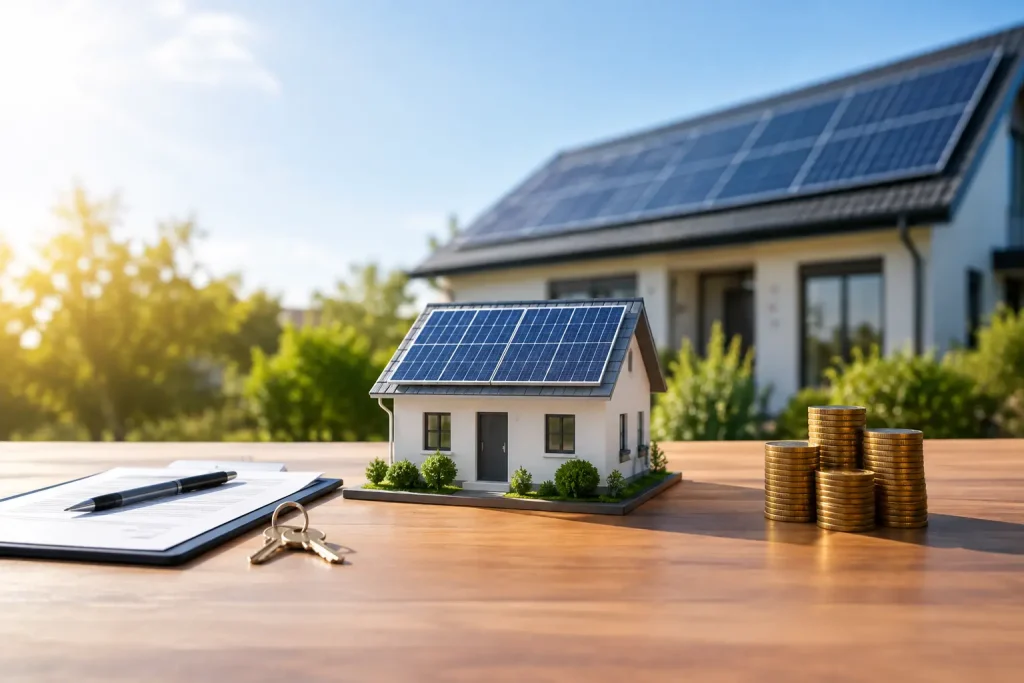
A solar quote can look attractive for two very different reasons: one option keeps the upfront cost low, while the other gives you a system that is fully yours from day one. The solar lease vs ownership decision affects far more than your monthly payment. It determines who receives the export income, who controls future upgrades and how much value the system can add over its working life.
For most UK homeowners and businesses, buying a solar PV system outright delivers the strongest long-term return. A lease can still suit certain properties and budgets, but it needs careful checking before you sign.
What does solar ownership mean?
Owning solar panels means you buy the equipment and it becomes part of your property. You may pay from savings, use a loan or arrange finance, but once any finance agreement is cleared, the panels, inverter and battery are yours.
You use the electricity your panels generate first, reducing the amount you need to buy from the grid. Any surplus can be exported to the grid through a Smart Export Guarantee tariff, subject to your supplier’s terms. If you add a solar battery, you can store more of your generation for use later in the day, rather than exporting it at a lower rate.
Ownership also gives you control. You can choose when to add battery storage, an EV charger, an air source heat pump or further panels, provided the system design and network permissions allow it. This matters when you are planning wider energy improvements rather than treating solar as a standalone purchase.
What is a solar lease?
A solar lease is an agreement in which a third party owns the solar panels installed on your roof. You usually make a regular payment to use the system, or buy its generated electricity under a related power purchase agreement. The provider may be responsible for monitoring, servicing and certain repairs during the contract.
The main attraction is obvious: you can install solar with little or no upfront payment. For households facing high energy bills but without capital available, this can make renewable electricity more accessible.
However, leasing is less common in the domestic UK market than it was during earlier solar incentive schemes. The terms vary widely, and a low starting payment does not automatically mean lower costs over 20 or 25 years. You need to establish exactly what you are paying for, how payments rise over time and who benefits from the electricity and export payments.
Solar lease vs ownership: the key differences
The practical difference comes down to cost, control and long-term value. With ownership, you make the investment and keep the financial benefits. With a lease, the provider takes some responsibility and risk, but also retains a share of the return.
Upfront cost and monthly payments
A lease can reduce the initial cost significantly. This is useful if protecting cash flow is your main priority, particularly for a business with other planned capital expenditure.
Buying outright costs more at the start, although finance can spread payments. The important comparison is not simply the monthly figure. Compare the total amount payable over the full term, including interest, annual price rises, administration charges and any end-of-contract costs.
A financed owned system may have a higher monthly cost initially, yet become much more cost-effective once the finance is repaid. A leased system may continue to require payments for the whole contract period.
Savings and export income
With an owned system, the electricity you use in the property reduces your imported grid electricity. You can normally receive payment for eligible exported electricity through the Smart Export Guarantee, provided the installation and metering arrangements meet the supplier’s requirements.
With a lease, you must check whether you retain the export income, share it with the provider or receive none of it. You should also confirm whether you are purchasing solar-generated electricity at a fixed rate, whether that rate increases annually and how it compares with your expected grid tariff.
The highest savings usually come from using more of your own generation. Daytime electricity use, battery storage, EV charging and timed appliances can all improve this. If you have high daytime demand, ownership can be particularly compelling because you keep more of the value created on your roof.
Maintenance and system performance
Solar PV systems generally require limited maintenance, but inverters, batteries and monitoring equipment have different warranties and expected lifespans. A lease may include maintenance and performance monitoring, which can be reassuring if you do not want responsibility for the equipment.
With ownership, a quality installation, clear product warranties and suitable system monitoring provide similar confidence. You have the freedom to select your installer and equipment specification, rather than accepting what a lease provider offers. For many property owners, that control outweighs the convenience of a lease maintenance package.
Selling, remortgaging or altering your property
This is where lease terms deserve particular attention. A long roof lease can complicate a sale or remortgage because a buyer and their lender may need to review and accept the agreement. You may also need the lease provider’s consent to carry out roof repairs, build an extension or remove the panels.
Owned panels are usually more straightforward, although purchasers will still want documentation showing the installation was completed correctly. Keep your MCS certificate, electrical paperwork, warranties and any relevant network approval documents in a safe place.
If your roof is likely to need replacement in the next few years, address that before installing solar. Removing and refitting panels adds cost whichever route you choose, but ownership gives you more direct control over the work and timing.
When leasing may make sense
A solar lease is not automatically the wrong choice. It may work for a property owner who cannot access affordable finance, has limited capital and values a fully managed arrangement. It can also be considered by businesses that prefer predictable operating costs over capital investment.
Even then, ask for the full agreement in writing and allow time to review it. Check the contract length, annual payment increases, early termination terms, roof access rights, insurance responsibilities, performance guarantees, battery ownership and what happens when the agreement ends. Establish whether you can buy the system later and how that price will be calculated.
Do not base the decision on projected savings alone. Savings estimates depend on roof orientation, shading, electricity use, tariff changes and how much solar electricity you use on site. A good proposal should explain these assumptions clearly rather than promise a fixed saving that cannot be guaranteed.
Why ownership is often better for UK properties
For an owner-occupier planning to remain in their home, solar ownership is normally the clearer route to long-term value. After the initial investment is recovered, the system can continue producing low-cost electricity for many years. You retain the export income, choose future upgrades and avoid a third-party interest over your roof.
It is especially effective when solar is designed as part of a wider energy plan. A battery can increase self-consumption. An EV charger can use surplus daytime generation. A heat pump can reduce reliance on gas, while thoughtful controls help match demand with solar output. These technologies work best when they are planned together around the property, its energy use and the owner’s goals.
For landlords, ownership can also support lower running costs for tenants and improve the appeal of the property. The arrangement must be clear where electricity is supplied to a tenant, but there is no need to hand long-term roof rights to a third party simply to access solar generation.
Questions to ask before choosing either option
Before approving a solar proposal, make sure you can answer these points. Who owns the equipment at installation and at the end of the agreement? What is the total cost over the full term? Who receives export payments? What warranties are included? What happens if the roof needs work or you sell the property? And does the system include an MCS-certified installation where required for the benefits you expect to access?
Also ask for an estimate based on your actual electricity use, not a generic household figure. A system should be sized for your roof, consumption pattern and future plans. Oversizing a system without a battery or suitable daytime demand may increase exports without increasing savings as much as expected.
Airtech Renewables can help property owners assess solar panels, battery storage, EV charging and other low-carbon systems as one practical energy solution. The right answer is not the option with the lowest first payment. It is the arrangement that gives your property reliable savings, clear responsibilities and the flexibility to benefit from cleaner energy for years to come.