
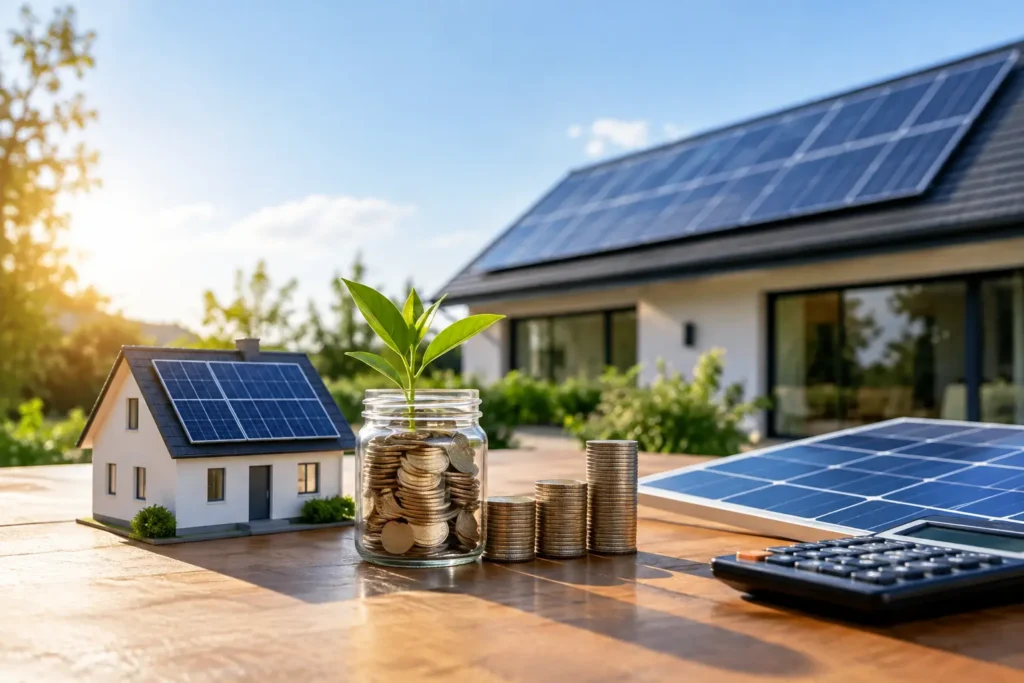
A solar system should do more than look good on the roof. It should reduce the electricity you buy, give you more control over rising energy costs and deliver a clear long-term return. Solar payback UK figures vary from property to property, but a well-designed installation can commonly repay its cost in around 8 to 14 years, with savings continuing for decades afterwards.
That range is useful as a starting point, not a promise. The right answer depends on your roof, electricity consumption, tariff, daytime habits and whether you add battery storage. A proper assessment turns broad estimates into a plan based on how your home or business actually uses power.
Solar Payback UK: the realistic range
Solar payback is the time it takes for the savings and income from a solar PV system to equal its upfront installation cost. Once that point is reached, the electricity generated continues to provide value. Modern solar panels are designed for a long working life, often backed by product warranties of 25 years or more, although output naturally reduces gradually over time.
For many UK households, solar PV without a battery may achieve payback in roughly 9 to 14 years. Properties with high daytime electricity use, a favourable roof and strong self-consumption can see a shorter timeframe. Businesses that operate through the day can also benefit because their demand often aligns closely with solar generation.
A battery can improve how much solar electricity you use yourself, particularly in the evening and overnight. However, it adds to the initial investment, so it does not automatically produce the fastest payback. Its value is often strongest where a property has substantial evening demand, an electric vehicle, time-of-use electricity tariffs or a desire for greater energy independence.
What determines how quickly solar panels pay for themselves?
The biggest factor is not simply how many panels you install. It is how much of their generation replaces electricity that you would otherwise have bought from the grid. Using solar power in the property is generally worth more than exporting it, because retail electricity prices are usually higher than export payments.
Your electricity use during daylight hours
A home that is empty from morning to late afternoon will use less solar power directly than a home with somebody working remotely, running appliances or charging an electric vehicle during the day. This does not mean solar is unsuitable for households with daytime absences. Export payments still provide value, and a battery may store surplus generation for later use. It does mean that daily habits influence the result.
Simple changes can improve returns without changing the system itself. Setting a dishwasher, washing machine or immersion heater to run when solar production is high can increase self-consumption. Smart controls can make this easier, using surplus generation where it offers the greatest benefit.
Roof orientation, shading and usable space
A south-facing roof usually produces the highest annual generation, but east- and west-facing arrays can still be highly effective. An east-west layout spreads generation across the morning and late afternoon, which may better match household demand and reduce reliance on the grid at the most useful times of day.
Shading from trees, chimneys, neighbouring buildings or roof features must be assessed carefully. A small amount of occasional shade does not always rule out solar, but significant shade can reduce output. Panel layout, optimisers and suitable equipment selection can help in some cases, yet they should be specified for a genuine reason rather than added by default.
System cost and installation quality
A larger system generates more electricity, but the best size is not necessarily the largest roof can accommodate. The aim is to balance expected generation with current and future demand. For example, a household planning an EV, heat pump or electric hot water cylinder may sensibly install more generation than it uses today.
Quality matters to payback because poor design can limit performance for years. A professional installation should consider roof condition, cable routes, inverter location, generation estimates, electrical protection and future expansion. Choosing an MCS-certified installer is also important for homeowners who want access to Smart Export Guarantee payments from participating suppliers.
Export payments and electricity tariffs
The Smart Export Guarantee allows eligible small-scale generators to receive payment for electricity exported to the grid. Rates differ between suppliers and tariffs, so this income should be included in any payback calculation, but not overestimated. Exporting can make a material contribution, particularly during summer, while direct use of solar generation normally remains the priority.
Time-of-use tariffs can change the calculation further. If you have a battery, you may be able to charge it from lower-cost overnight electricity and use that stored energy when grid prices are higher. This is separate from solar generation, but it can improve the wider value of your energy system. The available tariffs and charging strategy should be reviewed before assuming savings.
A simple solar payback example
Consider a household that installs a solar PV system for £8,000. If it saves and earns a combined £850 per year through reduced imports and export payments, the simple payback is just over nine years. If electricity prices rise, the same solar generation may offset more expensive grid electricity, potentially improving the return. If the household uses very little power during the day and exports most of its generation at a lower rate, payback could take longer.
This is why headline figures alone can mislead. A system quoted at a lower price is not always better value if it is undersized, has poor generation potential or cannot support planned additions such as a battery or EV charger. Equally, an expensive battery is not automatically justified if your usage profile does not benefit from it.
A sensible quotation should show the expected annual generation, estimated self-consumption, likely export amount and the assumptions used for electricity and export prices. Ask for the figures to be explained in plain English. You should be able to see where the savings are expected to come from.
How to shorten your payback period
The strongest returns come from matching generation to the way a property operates. Start with your electricity bills and look at annual consumption, not just one winter month. Then consider changes likely within the next few years, such as home working, an electric vehicle, an extension, a heat pump or growing business activity.
Using more electricity while the sun is shining is the practical first step. Smart appliance scheduling, daytime EV charging and controlled hot water heating can all help. A battery is worth assessing where it allows a meaningful amount of surplus solar to be used later, but it should be sized around your needs rather than selected as a standard add-on.
For commercial properties, solar can be especially compelling where lighting, refrigeration, equipment, office loads or manufacturing processes run through the day. Reducing imported electricity during working hours can support lower operating costs and improve budget certainty. A business should also consider whether its roof area, lease position, metering arrangement and future energy demand support the investment.
Do solar panels still make sense after payback?
Yes. Payback is a useful financial measure, but it is not the only benefit. After the installation has paid for itself, ongoing generation can continue to reduce electricity purchases for many more years. Solar can also lower a property’s carbon impact, support electrification and make a home or commercial building better prepared for changing energy costs.
There are practical responsibilities. Panels should be installed on a sound roof, generation should be monitored, and equipment warranties should be understood. Most systems need little day-to-day attention, but checking performance can identify faults or unusual drops in output before they affect savings for long.
The most effective solar investment is one designed around the property rather than a generic package. When the system size, roof layout, battery option and future energy plans work together, solar becomes a straightforward way to keep more of your energy spend under your own control.