
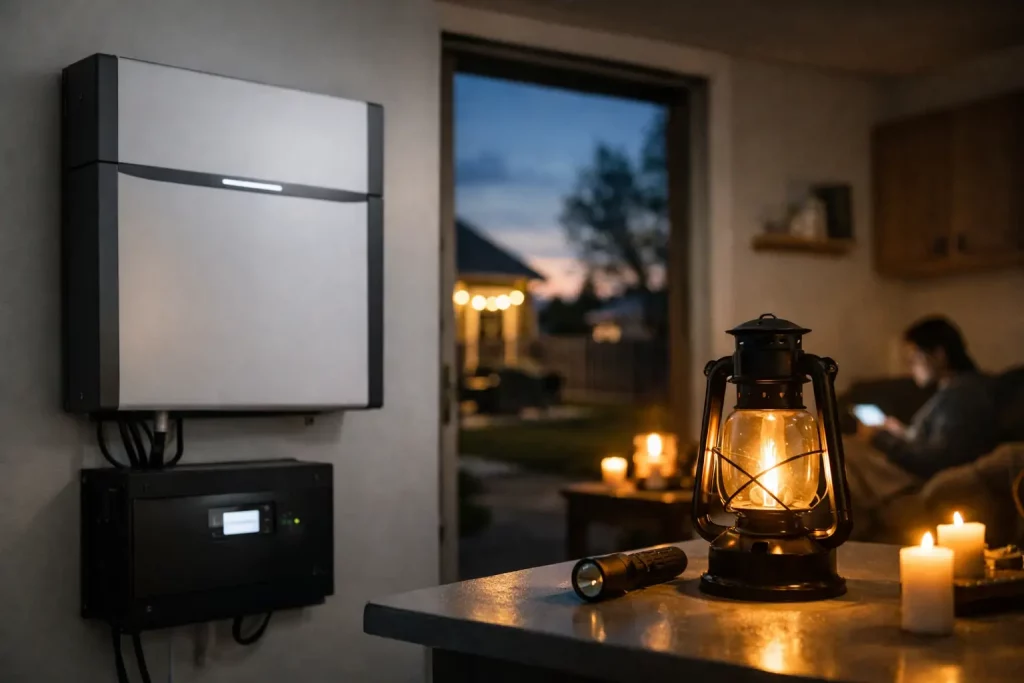
A power cut changes the value of stored electricity very quickly. The lights may be off, the Wi-Fi may have stopped and a freezer full of food becomes a real concern. Battery storage for power cuts gives a home or business a reserve of electricity that can take over when the grid is unavailable, helping essential services stay on until supply returns.
For many UK property owners, the appeal is not about running every electrical item as normal. It is about protecting the things that matter most: lighting, broadband, refrigeration, mobile charging, selected sockets and, in some homes, controls for heating systems. The right system can also reduce day-to-day electricity costs by storing cheaper or self-generated energy for later use.
How battery storage for power cuts works
A solar battery stores electricity as direct current, usually from solar panels or from the grid at lower-cost times. An inverter converts that energy into the alternating current used by appliances. During normal operation, the battery can supply the property when solar generation is low or grid electricity is expensive.
However, a standard battery installation does not automatically provide backup in a power cut. For safety, most grid-connected solar systems switch off when the local network fails. This prevents electricity being fed back into lines while engineers may be working on them.
To keep selected circuits live, the system needs a backup function. Depending on the equipment and property, this may be called emergency power supply, EPS, backup gateway or whole-home backup. It safely separates the property from the grid, then allows the battery and inverter to power agreed circuits independently.
That distinction matters. If power-cut protection is a priority, it should be part of the design brief from the start rather than an assumption made after installation.
What can a home battery power during an outage?
The answer depends on the battery capacity, inverter output and the way your consumer unit is configured. A battery may hold enough energy to run modest essentials for many hours, but it cannot necessarily start or support every high-demand appliance at once.
A carefully designed backup circuit commonly covers lighting, a fridge-freezer, broadband router, television, laptop chargers and selected sockets. It can also support security equipment and controls for a gas boiler or heat pump, although the heating system’s actual electricity demand must be assessed. This can make a major difference to comfort during a winter outage.
High-load appliances need more thought. Electric ovens, showers, immersion heaters, tumble dryers, kettles and some air conditioning units can drain a battery quickly. An EV charger is also unlikely to be an appropriate backup load. Whole-home backup is possible with suitable equipment and a larger battery, but it comes at a higher cost and still requires sensible energy use while the grid is down.
For commercial sites, priorities may include IT equipment, emergency lighting, tills, communications, refrigeration or critical process controls. The best approach is to identify what cannot be allowed to stop, rather than attempting to power the entire building without limits.
Capacity and power are not the same thing
Battery capacity is measured in kilowatt-hours, or kWh. It indicates how much energy is available. A 10 kWh battery could theoretically supply a continuous 1 kW load for around 10 hours, though real-world usable capacity and system losses will affect the result.
Power output is measured in kilowatts, or kW. It determines how much the battery can deliver at one time. A battery with ample stored energy may still struggle if several appliances demand more power than its inverter can provide. Both figures are essential when planning backup protection.
Choosing the right battery size
There is no single best battery size for power cuts. A household that wants to keep a few essentials running for an evening may need a very different setup from a rural home with frequent interruptions or a business that relies on refrigerated stock.
Start by considering the likely duration of outages in your area and the loads you need to protect. A basic essentials package may be built around low consumption, while a larger battery can offer more flexibility and longer resilience. If you have solar panels, daytime generation can recharge the battery during an extended outage, provided the system has been designed to operate in backup mode.
Solar generation should not be treated as guaranteed backup energy. A short winter day, heavy cloud or snow-covered panels can significantly reduce output. The battery must still be sized to cover essential demand when solar production is limited.
It is also worth thinking beyond the next month. A growing family, an electric vehicle, home working, a heat pump or plans to add solar panels can all change electricity use. Some battery systems are modular, allowing extra capacity to be added later. This can make the initial investment more manageable while retaining room to expand.
Solar panels and batteries: stronger together
Solar panels and battery storage are a practical match. Instead of exporting surplus generation during the day and buying electricity back in the evening, you can store more of the energy produced on site. That can improve solar self-consumption and reduce reliance on grid electricity.
During a power cut, a solar-compatible backup system may extend the available supply by charging the battery when conditions allow. It is particularly useful in spring and summer, when daytime generation is stronger. Yet the system must manage available energy intelligently: charging a battery, running essential loads and protecting the equipment all need to happen within the inverter’s limits.
For properties without solar, battery storage can still provide backup protection. It may charge overnight on a suitable time-of-use tariff and supply electricity at more expensive times. The savings will depend on the tariff, household consumption pattern, battery size and how much stored power is used rather than exported or left unused.
Installation details that should not be overlooked
Backup battery systems involve more than choosing a capacity figure. The installer needs to assess the existing electrical installation, consumer unit, earthing arrangements, cable routes, location of the battery and inverter, and the circuits that should remain live in an outage.
Battery location matters for safety, access and performance. Equipment needs a suitable environment, with the manufacturer’s required clearances and protection from unsuitable temperatures or moisture. For a commercial property, the design may also need to account for operating hours, staff access and business continuity requirements.
A professional installation should make it clear what will happen when the grid fails. Will backup switch over automatically? Are only selected circuits covered? Can the battery be recharged from solar during an outage? How much power can it deliver? Clear answers avoid disappointment when the system is needed most.
At Airtech Renewables, battery storage can be designed as part of a wider energy solution, alongside solar panels, EV charging and low-carbon heating. Considering these systems together helps ensure the electrical design supports the way the property is used, rather than adding separate technologies with competing demands.
Is backup battery storage worth the investment?
For some households, the main return comes from lower electricity bills and better use of solar energy, with power-cut protection as valuable extra reassurance. For others, particularly people working from home, properties with vulnerable occupants or businesses where downtime is costly, backup capability may be the deciding factor.
The trade-off is cost. A battery with emergency backup hardware and a dedicated circuits arrangement will usually cost more than a battery installed only for energy shifting. Larger systems provide more resilience, but only make financial sense if the capacity and output will genuinely be used.
The most effective solution is usually not the biggest battery available. It is a system matched to your essential loads, solar generation, tariff and budget. A well-planned battery can keep the important parts of a property operating when the grid goes down, while delivering useful savings every day it does not.