
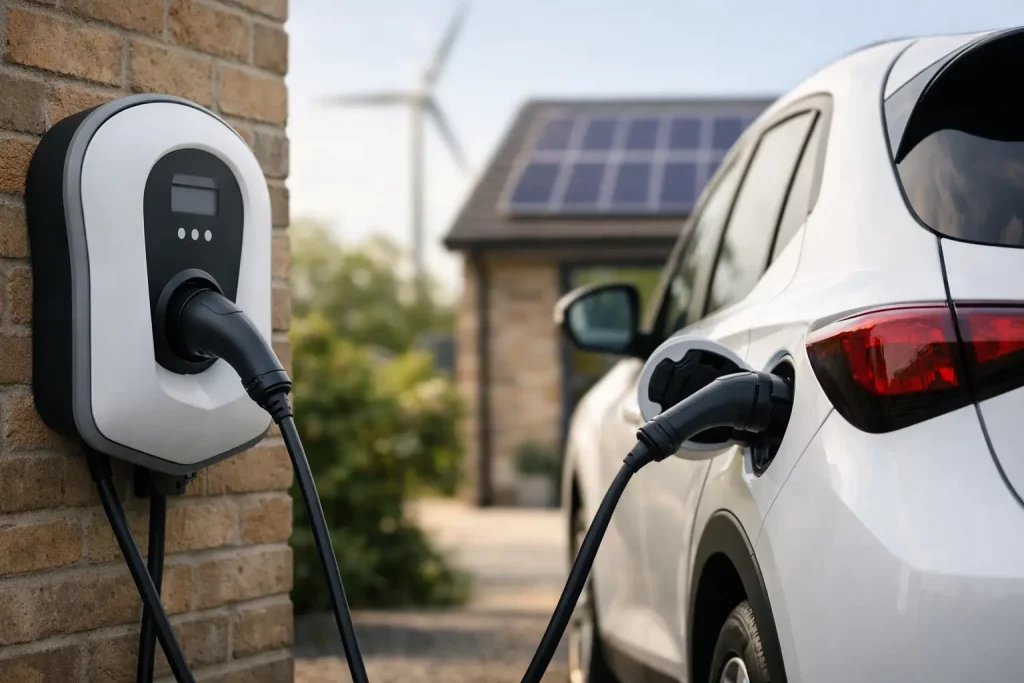
A home EV charger should do more than refill a car battery overnight. For households with solar panels, it should help put more of their own generation into the vehicle rather than exporting it to the grid for a lower rate. That is the main reason a myenergi Zappi review search in the UK is so common: Zappi is designed around solar charging first, while still working as a capable everyday smart charger.
For the right property, it can be an excellent investment. It is not automatically the cheapest route to charging an electric vehicle, however, and its value depends on your solar system, driving pattern, electricity tariff and the quality of the installation.
What is the myenergi Zappi?
The myenergi Zappi is a smart EV charge point made for UK homes and businesses. It is available in tethered and untethered versions, with options suited to single-phase and three-phase supplies. Its defining feature is the ability to monitor electricity flowing to and from a property, then adjust charging to make use of surplus solar generation.
A standard charger will charge whenever it is scheduled or plugged in. Zappi can do that too, but it adds a more useful choice for solar households: it can wait for spare generation, charge from a blend of solar and grid power, or charge at full available speed when time matters.
This makes it a strong fit for homeowners who are investing in solar panels, battery storage and electric vehicles as part of one lower-carbon energy system. Rather than treating vehicle charging as another large electricity demand, Zappi gives you more control over when that demand is met.
myenergi Zappi review UK: the features that matter
Zappi offers three familiar charging approaches: Fast, Eco and Eco+. The names are simple, and so is the practical difference between them.
Fast charging prioritises getting the vehicle charged. It draws from the grid as needed and is the best setting when you need a predictable amount of charge by morning or before a longer journey. Eco charging can use surplus solar but will top up from the grid where necessary to maintain charging. Eco+ is the setting aimed at maximising self-consumption, pausing and restarting charging as surplus generation rises and falls.
That flexibility is the product’s strongest point. On a bright weekday, a household working from home may be able to add useful mileage largely from solar power. On a wet December afternoon, the same household can switch to an off-peak schedule and still have the car ready when it is needed.
The charger can also be set up with timed schedules, helping owners take advantage of lower overnight electricity rates. This is particularly useful because solar charging and cheap tariff charging are not competing ideas. They solve different problems. Solar can be highly valuable during the day, while an off-peak tariff can often be the most cost-effective option overnight and through the darker months.
Zappi forms part of the wider myenergi ecosystem, which can include solar diverters and battery storage products. This can be useful where a property has several electrical loads to manage, such as an immersion heater, home battery and EV. However, buying into an ecosystem is not essential simply to get a good EV charger. Zappi works well as a standalone charging solution when it is correctly specified and installed.
Where Zappi performs well
For a property with solar panels and an EV that is often at home during daylight hours, Zappi makes a compelling case. This could include people working from home, retired households, company car drivers with daytime parking, or families with a second vehicle that is not used every day.
It is also well suited to owners who want visibility and control rather than a basic plug-in-and-forget charge point. Watching the charger respond to surplus generation gives a clearer picture of how a home uses energy. Over time, that can encourage better habits, such as running flexible appliances at times when the solar array is productive.
The product is particularly attractive when installed alongside a new solar system. The charger, generation and monitoring equipment can be planned together, cable routes can be considered before external finishes are completed, and the installer can make sure the system is set up to prioritise energy in the way the household actually wants.
For landlords and businesses, Zappi can also be a sensible option where solar is installed on site and vehicles are parked for several hours at a time. The key is to assess expected usage honestly. A workplace car park with vehicles arriving at 9am and leaving at 5pm may benefit far more from solar-led charging than a site where vehicles turn around quickly throughout the day.
The limitations to consider before buying
No solar charger can create free electricity when the sun is not generating. In the UK, output changes significantly with season, weather, roof orientation and shading. A Zappi can make excellent use of a surplus, but the surplus must exist in the first place.
Charging speed is another consideration. A typical EV needs a minimum level of power before it can begin charging. When clouds pass over, a solar-led session may pause or run at a lower rate. That is normal behaviour, not a fault. If a car must be fully charged by a fixed time, an off-peak schedule or Fast mode is often the more reliable choice.
There is also a cost question. Zappi is usually positioned as a premium solar-capable charger rather than the lowest-priced smart charger on the market. The upfront difference can be worthwhile if it helps you use more of your own generation, but it may be harder to justify for a household without solar and with little intention of adding it.
Finally, the installation is as important as the charger itself. The property needs suitable electrical capacity, safe cable routing and correct monitoring at the incoming supply. Older consumer units, long distances between the parking area and electrical intake, or difficult groundworks can increase the installed cost. A good quote should account for these factors rather than offering a headline price that changes later.
Is Zappi better with solar battery storage?
It depends on the household’s priorities. A battery can store surplus solar for use later in the day, while an EV can absorb a much larger amount of energy when it is parked at home. Both are useful, but they do different jobs.
If the car is regularly at home in daylight, direct solar charging can be an efficient use of generation. There are fewer conversion steps than charging a home battery and then using that battery to charge the vehicle. If the car is away during the day, battery storage may offer more benefit by keeping solar energy available for evening household use.
The best arrangement is often based on daily routines rather than maximum equipment. A household with a small solar array, a modest annual mileage and a cheap overnight tariff may not need a large battery to make EV charging affordable. Conversely, a home with higher electricity use, regular daytime generation and multiple flexible loads may benefit from a fully integrated setup.
Tethered or untethered Zappi?
A tethered Zappi has a charging lead permanently attached. It is usually the most convenient choice for homeowners, particularly in poor weather, because the cable is always ready at the drive. The practical downside is that the lead is visible when not in use and should be selected at the right length for the parking position.
An untethered model has a socket instead, so you use the cable supplied with the vehicle. It can look neater and may suit properties where different connector arrangements need to be accommodated. The trade-off is having to retrieve and store a cable each time you charge.
For most domestic installations, convenience should lead the decision. If the charger is at the front of the property and will be used most days, tethered is often the straightforward choice.
What to ask for in an installation quote
A proper Zappi quotation should cover more than the charge point itself. Ask how the incoming supply and consumer unit will be assessed, where the charger and monitoring equipment will be positioned, and whether the proposed cable route is visible or concealed. If solar panels, a battery or a heat pump are already installed, make sure the installer knows about them.
It is also worth asking how the charger will be configured for your preferred charging routine. For example, you may want solar surplus during the day, then a scheduled overnight top-up on an off-peak tariff. This is a simple aim, but it needs to be discussed before handover so the system works around your life rather than leaving you to work it out later.
Airtech Renewables can assess EV charging as part of a wider solar, battery storage and home energy plan, helping ensure the equipment is sized and installed for practical savings rather than simply added to the wall.
Our verdict
Zappi is one of the strongest choices for UK homeowners who want to connect EV charging with solar generation. Its real advantage is not that it always charges for nothing. It is that it gives you useful control: take surplus solar when it is available, use cheaper grid electricity when it is not, and prioritise certainty when the car needs to be ready.
If you have solar now, or expect to add it soon, the additional capability can justify the higher initial cost. If you only need a straightforward overnight charger and have no interest in solar-led charging, a simpler smart charger may offer better value. The right choice starts with your parking pattern, your tariff and how you plan to use energy at home over the next few years.