
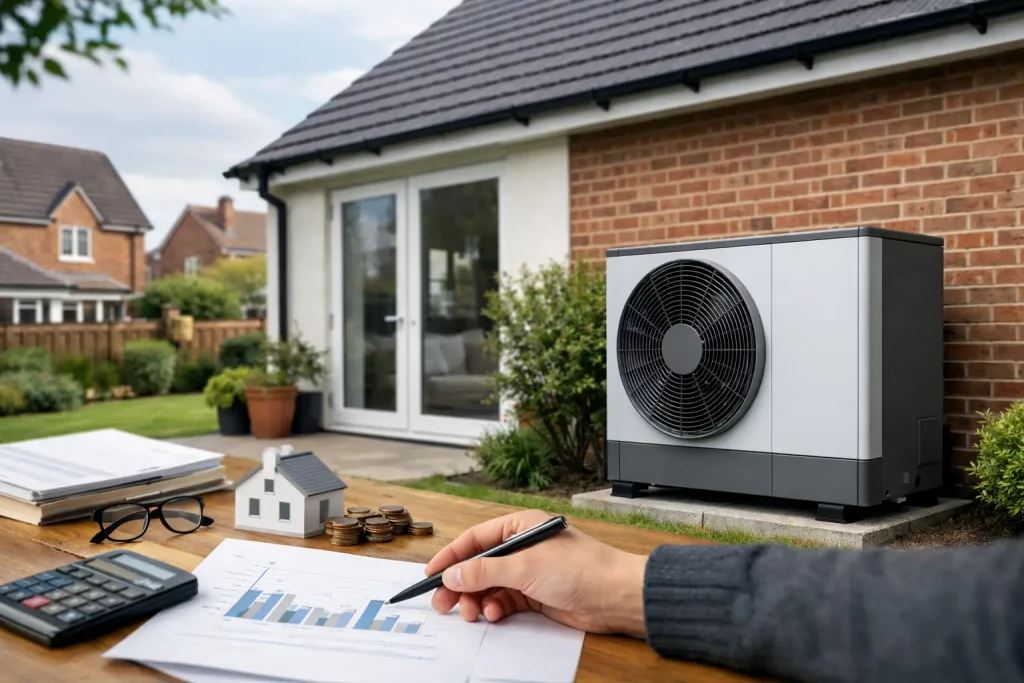
A high heating bill is rarely caused by one problem alone. It is usually the result of an older boiler, heat escaping through the building fabric and controls that do not match how the household lives. This heat pump savings case study follows a realistic UK family home to show what changes when a gas boiler is replaced with an air source heat pump – and why the design work matters as much as the unit itself.
The figures are illustrative rather than a promise of a fixed saving. Every property has different insulation levels, radiator sizes, energy tariffs and hot water use. However, they reflect the kind of outcome a well-planned installation can deliver when the system is suited to the home.
The starting point: an expensive-to-heat family home
Our example is a three-bedroom semi-detached house in the Midlands, built in the 1970s. The owners, a family of four, had a working but ageing gas combi boiler. During colder months, several rooms felt chilly despite the thermostat being set at 21°C, while the upstairs bedrooms could become uncomfortably warm.
The property already had double glazing and loft insulation, but it still needed practical improvements before a heat pump would perform at its best. The household used around 14,000 kWh of gas per year for space heating and hot water, plus 3,800 kWh of electricity for appliances, lighting and cooking.
At the energy prices used for this example, annual gas costs were approximately £1,260, including the standing charge. Electricity cost around £1,140 a year. Their total annual energy spend was therefore close to £2,400.
The family wanted more predictable running costs, lower household emissions and a heating system that would not depend on replacing another gas boiler in a few years. They were also considering solar panels, so they wanted a solution that could work alongside future generation and battery storage.
Heat pump savings case study: the recommended solution
The first step was not selecting the heat pump. It was assessing the property. A room-by-room heat-loss calculation identified how much heat each space needed on the coldest expected day. This is essential. Oversizing can increase upfront cost and lead to inefficient cycling, while undersizing may leave the home short of heat when it is needed most.
The assessment found that the existing boiler had been considerably oversized, which is common in homes with older boiler replacements. The recommended system was an 8kW air source heat pump, paired with a properly sized hot water cylinder, weather-compensating controls and selected radiator upgrades.
The home also received additional loft insulation and draught reduction measures around external doors. These are not glamorous improvements, but they reduce heat loss and help the heat pump maintain steady temperatures with less energy.
A hot water cylinder was necessary because, unlike a combi boiler, an air source heat pump stores hot water for household use. The cylinder was sized for a family of four, allowing enough hot water for normal morning and evening demand without wasting energy on an unnecessarily large store.
Three downstairs radiators and one bathroom radiator were replaced with larger models. Heat pumps work most efficiently at lower flow temperatures than traditional gas boilers. Larger radiators can release the required heat into a room without forcing the system to run hotter. Underfloor heating can be even more effective in suitable areas, but it was not required throughout this property.
What changed after installation
The family kept the indoor temperature at a consistent 20°C, rather than turning the heating sharply up and down. This approach suits heat pumps, which are designed to maintain comfortable conditions steadily rather than deliver short bursts of very high heat.
Over a full year, the heat pump used approximately 5,100 kWh of electricity for space heating and hot water. That figure includes seasonal variation: less energy was needed in mild weather and more during the coldest winter periods.
With an electricity tariff of 27p per kWh, this equated to roughly £1,377 for heating and hot water electricity. There was no longer a gas standing charge, saving a further annual cost. On heating alone, the new system was broadly comparable with the previous gas bill at the example prices used.
That may sound less dramatic than some headline claims, but it is an honest and useful result. A heat pump is not always a simple like-for-like bill reduction if electricity remains significantly more expensive than gas. Its value comes from high efficiency, reduced carbon emissions, improved comfort and its ability to work with lower-cost electricity and on-site solar generation.
The more substantial saving arrived when the household added a 4.5kW solar PV system and a home battery. The solar panels generated electricity during the day, while the battery stored surplus power for evening use. The heat pump could also be scheduled to heat the cylinder during lower-cost tariff periods or when solar generation was available.
After allowing for exported electricity, solar self-consumption and off-peak charging, the household’s annual electricity costs fell by an estimated £650 compared with buying all electricity from the grid at a standard rate. Their combined energy spend reduced from around £2,400 to approximately £1,870 per year.
That represents an annual saving of about £530 in this example, while giving the family a modern heating system, more stable room temperatures and a route away from fossil fuel heating. Actual results will move with energy prices, weather, system settings and household habits.
Comfort was as important as the bill
The homeowners noticed the comfort difference before they saw a full year of figures. The upgraded radiators warmed rooms more evenly, and the weather-compensating controls adjusted the system output as outdoor temperatures changed. Instead of radiators becoming very hot for a short time, they stayed gently warm while the house held its set temperature.
The hot water cylinder also changed how the family used hot water. There was a short adjustment period while they learned the best heating schedule and boost settings. Once set correctly, there was sufficient hot water for daily use without regularly relying on an electric immersion heater.
Noise was another concern before installation. A correctly positioned external unit produces a low, steady sound, similar to other outdoor home equipment. Site location matters, especially for properties with close neighbours, small gardens or bedroom windows nearby. A professional survey should consider clearances, airflow and planning requirements before work begins.
Why savings vary between homes
A case study is useful only when its limits are clear. The same heat pump will not produce the same saving in every property. The biggest factors are the home’s heat loss, the existing fuel being replaced, the electricity tariff and the temperature at which the system needs to run.
A well-insulated home with adequately sized radiators may achieve very efficient operation at lower flow temperatures. A poorly insulated home can still use a heat pump, but fabric improvements may be the best first investment. In some cases, upgrading insulation, sealing draughts or replacing a few radiators delivers a better return than trying to make a heat pump work harder.
Households replacing electric resistance heating, oil or LPG often see a clearer reduction in running costs because heat pumps can produce several units of heat for each unit of electricity consumed. Those replacing mains gas may find the financial case depends more heavily on using an off-peak electricity tariff, generating solar power or avoiding future boiler replacement costs.
The installer also makes a major difference. Good results depend on accurate heat-loss calculations, correct unit sizing, suitable pipework, hydraulic design, commissioning and clear guidance on controls. An MCS-certified installation can also support eligibility for relevant funding where available, subject to scheme terms and property requirements.
Making the investment work harder
For this household, the heat pump was the foundation of a wider energy plan rather than a standalone purchase. Solar panels reduced reliance on grid electricity, battery storage increased the use of self-generated power, and smart controls helped match heating demand to lower-cost periods.
This approach is not essential for every home. A heat pump can be an excellent replacement for a boiler on its own, particularly where comfort, lower carbon heating and long-term property improvement are priorities. But combining technologies can make the financial return stronger and give owners more control over future energy costs.
Airtech Renewables designs low-carbon systems around the property and the people using it, from air source heat pumps and cylinders to solar, batteries and EV charging. The right starting point is a proper survey, not a generic savings figure. When the system is designed for how your home loses and uses heat, cleaner heating becomes a practical investment rather than a leap into the unknown.