
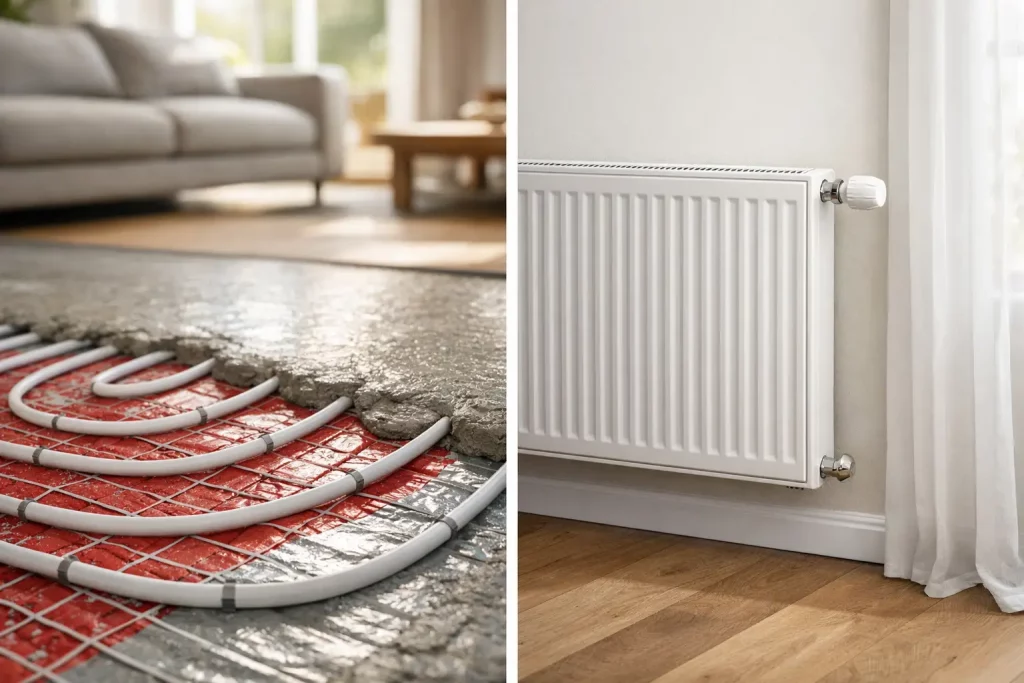
If you are replacing an old heating system, the choice between underfloor heating vs radiators quickly stops being theoretical. It affects running costs, comfort, room layout and how well your home or commercial property will work with low-carbon technology in the years ahead.
The right answer depends on the building, the budget and what you want the system to deliver. Radiators remain a familiar and effective option. Underfloor heating offers a different kind of comfort and can work especially well in modern, energy-efficient properties. The key is not deciding which is fashionable, but which is the better fit for your space.
Underfloor heating vs radiators: the main difference
Radiators heat a room by warming the air around a fixed point on the wall. That heat then circulates through the space. It is a proven approach, and in many homes it does the job well, especially where insulation is decent and the system has been sized properly.
Underfloor heating works across the whole floor area, spreading heat more evenly from the ground up. Instead of creating hotter and cooler zones around the room, it gives a more consistent temperature. Many property owners notice the difference straight away, particularly in kitchens, bathrooms and open-plan living areas where cold spots can be more obvious.
That difference in heat delivery has a knock-on effect on efficiency, control and comfort. It also matters when you are pairing your heating system with an air source heat pump, where lower flow temperatures generally improve performance.
Comfort and room feel
Radiators can warm a room quickly, which is one reason they are still popular. If you want a spare room heated fast for short periods, radiators can be practical. They suit properties where heating demand changes through the day and where quick response matters more than gentle, background warmth.
Underfloor heating is slower to respond, but it creates a very different feel once it is up to temperature. The heat is softer and more even. Floors feel warmer underfoot, and the room is comfortable across the full space rather than mainly around the radiator.
This matters more than many people expect. In family homes, it can make everyday living noticeably more comfortable. In commercial settings, it can improve the feel of reception areas, studios, retail spaces and offices where comfort needs to be steady rather than uneven.
Running costs and efficiency
For many customers, this is where the real decision sits. Lower heating bills are one of the main reasons people look at system upgrades in the first place.
Underfloor heating often runs at lower water temperatures than radiators while still delivering effective room heating. Because of that, it can be more efficient, particularly in well-insulated buildings. It is also a strong match for renewable heating systems such as air source heat pumps, which operate most efficiently at lower temperatures.
Radiators are not automatically expensive to run. Modern, correctly sized radiators paired with a well-designed system can still be efficient. The issue is that many existing radiator systems in UK properties were designed around older boilers and higher flow temperatures. If the wider system is outdated, the radiator setup may not be giving you the best return.
So when comparing underfloor heating vs radiators, it is better to think about the whole heating strategy rather than one component in isolation. Insulation levels, controls, pipework design and the heat source all affect the final running cost.
Installation costs and disruption
This is where radiators often have the simpler sales pitch. They are usually cheaper and easier to install, especially in existing homes where the pipework route is already in place. If you are replacing old radiators with new ones, the job can be relatively straightforward.
Underfloor heating usually costs more upfront. In a new build or major renovation, that extra cost is easier to justify because the floor structure is already being worked on. In retrofit projects, installation can be more disruptive depending on the system chosen. Floor height, existing floor finishes and access all need careful consideration.
That does not mean underfloor heating is only for new builds. Low-profile retrofit systems make it a realistic option in many existing properties. But it does mean the design and installation need to be right from the start. A cheaper installation that ignores floor build-up or heat loss can create problems later.
Which works better with a heat pump?
If you are planning a low-carbon heating upgrade, this is one of the most important questions to ask.
Underfloor heating is generally the stronger partner for an air source heat pump because both systems are designed to work efficiently at lower temperatures. That can help improve seasonal performance and reduce running costs over time. In practical terms, it means the heat pump does not need to work as hard to keep the property comfortable.
Radiators can still work with a heat pump, but they may need to be larger than standard models to deliver enough heat at lower flow temperatures. This is a common point that gets missed. Keeping existing radiators may sound cheaper at first, but if they are undersized, the system may struggle or operate less efficiently than expected.
For property owners looking at future-proofing, underfloor heating often has the edge. It aligns well with the wider move towards cleaner heating systems and lower-carbon homes.
Space, layout and appearance
Radiators take up wall space. In some rooms that is not a problem. In others, especially smaller properties or open-plan spaces, it limits furniture placement and affects the look of the room.
Underfloor heating frees up the walls completely. That gives more flexibility with layout and can support a cleaner, more modern finish. Developers and homeowners often value this in kitchens, extensions and high-spec refurbishments where appearance matters as much as heating performance.
There is also a practical angle. In rooms with large glazed areas or limited wall space, underfloor heating can solve design problems that radiators cannot address neatly. It is not only about aesthetics. It is about making the room easier to use.
Maintenance and reliability
Radiators are familiar, easy to understand and simple to replace if needed. If a valve fails or a unit needs upgrading, most heating engineers can deal with it quickly. That familiarity still counts for a lot.
Underfloor heating is reliable when it is properly installed, but access is more limited because the system sits beneath the floor. That makes good design, pressure testing and professional installation especially important. Once fitted correctly, maintenance demands are generally low, but mistakes during installation are harder and more expensive to put right.
This is one reason many customers prefer using one experienced installer who understands how heating, controls and renewable systems work together. A joined-up design reduces the risk of poor performance and helps protect the return on your investment.
Is underfloor heating always better?
No, and that is worth saying clearly.
Underfloor heating is not automatically the best option for every property. In an older home with limited insulation, suspended timber floors and a restricted renovation budget, upgrading a radiator system may be more practical. You may get better value from improving insulation, fitting smarter controls and choosing a more efficient heat source before taking on major floor works.
Equally, radiators are not old-fashioned by default. They remain a solid solution in many homes and commercial buildings. If the goal is a quick, affordable upgrade with minimal disruption, radiators may be the right choice.
The strongest results usually come from matching the system to the property rather than forcing one answer onto every building.
How to choose between underfloor heating vs radiators
Start with the basics. Is this a new build, an extension, a renovation or a straightforward heating replacement? Are you keeping a gas boiler for now, or moving to a heat pump? Do you want the lowest upfront cost, or the best long-term efficiency? Are you trying to free up space and modernise the layout, or simply improve comfort without major building work?
For new builds and major refurbishments, underfloor heating often makes very good sense. It offers excellent comfort, supports lower running temperatures and works well with renewable heating. For existing homes where disruption needs to stay low, radiators can still be the more practical route, especially when paired with a well-designed modern system.
Some projects benefit from a mixed approach. Underfloor heating may suit downstairs living areas, while radiators remain upstairs where heat demand and usage patterns are different. That kind of balanced design can deliver the best of both systems without overspending.
At Airtech Renewables, this is exactly where practical system design matters. A heating solution should not only work on paper. It should suit the building, support lower bills and leave you with a system that feels like a genuine upgrade every day.
If you are weighing up your options, the best choice is usually the one that matches how the property is built, how you use it and how you want it to perform over the next 10 to 20 years.