
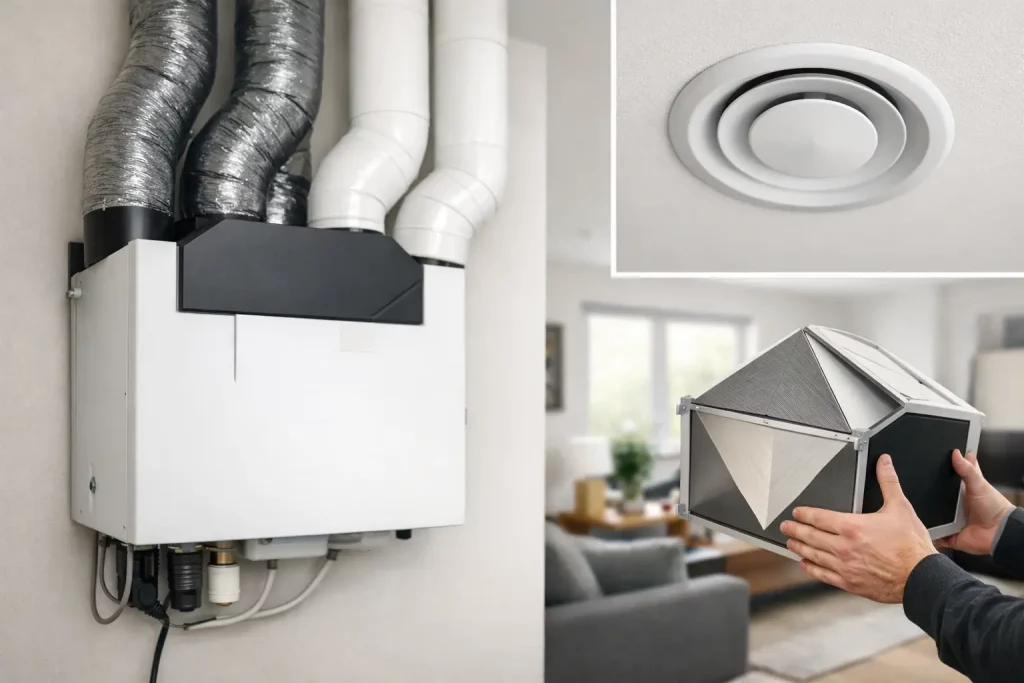
A warm home should not feel stuffy, damp or difficult to air. Yet opening windows to clear condensation or cooking smells can quickly let valuable heat escape. What is MVHR ventilation? It is a whole-property system designed to bring in fresh, filtered air while recovering heat from the stale air leaving the building.
MVHR stands for Mechanical Ventilation with Heat Recovery. It is particularly effective in modern, well-insulated homes, where draughts are reduced and natural airflow is limited. Rather than relying on trickle vents, extractor fans and open windows alone, an MVHR system manages ventilation continuously and efficiently.
For homeowners, landlords, developers and businesses, the result can be a fresher, more comfortable indoor environment with less wasted heat and better control over moisture.
What is MVHR ventilation?
An MVHR system uses a central ventilation unit and a network of ductwork to extract stale, humid air from rooms such as kitchens, bathrooms, utility rooms and WCs. At the same time, it supplies fresh outdoor air to living rooms, bedrooms and workspaces.
The two air streams pass through a heat exchanger inside the unit. They do not mix. Instead, heat from the outgoing stale air is transferred to the incoming fresh air. This means the property receives a steady supply of cleaner air without the cold draughts and heat loss associated with opening windows in winter.
The system runs quietly in the background at a low speed for everyday ventilation. It can also increase extraction when humidity rises, such as during showering, cooking or drying clothes indoors.
The main parts of an MVHR system
A typical installation includes a heat recovery unit, insulated ducts, ceiling or wall vents, external intake and exhaust grilles, and controls. Filters within the unit help remove airborne particles from the incoming air before it enters the property.
The quality of the design matters as much as the equipment. Duct routes, vent positions, airflow rates and commissioning all affect how quietly and effectively the system operates. A poorly designed system can be noisy or uneven, while a properly specified installation delivers balanced ventilation throughout the building.
How heat recovery works in practice
Think of a family home on a cold January evening. The kitchen and bathrooms produce warm, moist air, while bedrooms and living areas need fresh air for comfort and sleep quality. With conventional extractors, the warm air is expelled outside and replacement air enters through gaps, vents or opened windows.
With MVHR, the warm extracted air still leaves the home, but much of its heat is retained by the heat exchanger. Incoming outdoor air is pre-warmed before it reaches the living spaces. The unit uses electricity to run its fans, but this is typically far less costly than replacing large volumes of heated indoor air with cold air.
It is not a heating system in its own right. MVHR cannot replace radiators, underfloor heating or a heat pump. Its role is to reduce ventilation-related heat loss and support a more efficient heating strategy.
Why install MVHR ventilation?
The most immediate benefit is improved air quality. Homes and commercial spaces can hold moisture, carbon dioxide, odours, cleaning-product fumes and airborne pollutants, especially when windows stay shut during colder months. Continuous ventilation removes stale air at source and introduces filtered fresh air where people spend most of their time.
This can help reduce condensation on windows and lower the risk of mould growth caused by persistent humidity. For landlords and property managers, that can mean a more resilient property and fewer issues linked to damp. For families, it can make bedrooms, kitchens and bathrooms feel noticeably fresher.
Heat recovery is the other major advantage. In an energy-efficient property, uncontrolled ventilation losses can make up a meaningful proportion of heating demand. Recovering heat from outgoing air helps protect the value of the warmth already paid for, reducing the workload on the heating system.
MVHR can also reduce reliance on open windows in busy, noisy or high-pollen locations. Filters can improve the quality of incoming air, although the level of filtration depends on the system specification and maintenance routine. Windows can still be opened whenever preferred – MVHR simply means they do not need to be the main method of everyday ventilation.
Is MVHR right for every property?
MVHR delivers its best results in airtight, well-insulated buildings. New-build homes, major renovations, passive-style homes and properties undergoing deep energy upgrades are often strong candidates because ductwork can be planned into the design from the outset.
It can be installed in existing homes too, but the project needs careful assessment. Retrofitting ducts through a finished property may require access above ceilings, within service voids, cupboards or loft spaces. Larger homes may need more complex duct runs, and restricted space can affect which unit and layout are suitable.
A leaky, poorly insulated property can still benefit from better ventilation, but heat recovery will have less impact if warm air is escaping through gaps in the building fabric. In these cases, improvements such as loft insulation, draught-proofing and upgraded windows may be worth considering alongside ventilation works.
There is also a cost and maintenance trade-off. MVHR requires professional design and installation, and filters need replacing regularly. It is not a fit-and-forget product. However, when installed correctly and looked after, it offers a long-term approach to ventilation that is far more controlled than relying on intermittent extractor fans.
MVHR, extractor fans and air conditioning
These technologies have different jobs, although they can work well together. Standard extractor fans remove moist or stale air from individual rooms, usually without recovering heat. They are common and affordable, but they do not provide balanced fresh-air supply across the whole property.
Air conditioning controls temperature and, depending on the system, can reduce humidity in cooling mode. It does not normally replace the continuous fresh-air exchange provided by MVHR. Likewise, an air source heat pump provides efficient heating and hot water, but it does not solve ventilation needs.
For a high-performing home, these systems can form part of one joined-up plan. A heat pump provides low-carbon warmth, insulation keeps that warmth in, and MVHR supplies fresh air while recovering heat that would otherwise be lost. Solar panels and battery storage can further reduce the cost of electricity used by household systems, depending on the property’s energy profile.
What to expect from installation
The process should start with a survey of the property and its intended use. An installer will consider the floor plan, room types, available space for the unit, duct routes, insulation levels and airtightness. They should also calculate airflow requirements rather than applying a one-size-fits-all design.
The MVHR unit is often installed in a loft, utility room, airing cupboard or plant space, provided there is suitable access for maintenance. Ductwork is then routed to each relevant room, with supply and extract valves positioned to support effective air circulation.
Once installed, the system must be commissioned. This involves setting and measuring airflow rates so that supply and extract volumes are properly balanced. The installer should explain the controls, boost settings and filter replacement schedule before handover.
For renovation projects, it is usually easiest to install MVHR while ceilings, floors or walls are already being opened up. Planning early can reduce disruption and help achieve a neater finish.
Looking after an MVHR system
Regular maintenance is straightforward but essential. Filters should be checked and replaced in line with the manufacturer’s guidance, often every six to twelve months depending on local air quality, occupancy and use. A blocked filter can reduce airflow, increase fan energy use and affect indoor air quality.
Vents should be kept clear and not covered by furniture or decorations. The system may also need periodic servicing to inspect the unit, condensate drain, heat exchanger and ducts. Avoid changing valve settings yourself, as this can upset the balance established during commissioning.
An MVHR system works best when it is allowed to run continuously at its normal background setting. Switching it off to save electricity can allow humidity and pollutants to build up, undermining the purpose of the installation.
Choosing the right approach for your property
MVHR is not about making a property airtight and trapping air inside. It is about replacing uncontrolled draughts with planned, filtered ventilation that retains more of the heat you have paid for. The right solution depends on the building fabric, available space, renovation plans and the wider heating system.
For a new build or energy-efficiency upgrade, discussing ventilation early can prevent expensive changes later. Airtech Renewables can assess how MVHR may sit alongside low-carbon heating, solar and other home comfort systems, helping create a practical package that supports lower running costs and a healthier indoor environment.
Fresh air and energy efficiency should not be competing priorities. With the right design, your property can have both.