
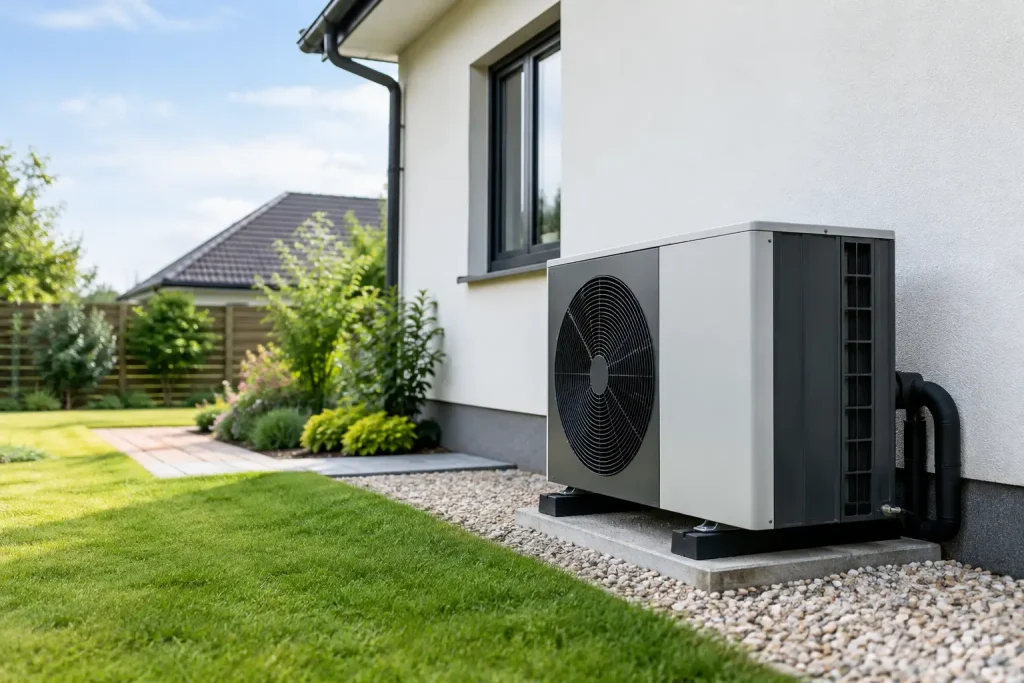
An air source heat pump can cut carbon emissions and provide efficient, dependable heating, but its position outside the property has a major effect on performance, noise and installation cost. The best heat pump locations give the unit a clear supply of outdoor air, sensible access for servicing and a short, practical route to the indoor heating system. Get this decision right before installation and the system will be easier to live with for years to come.
What makes a good heat pump location?
Unlike a boiler, an air source heat pump takes low-grade heat from the outdoor air and raises it to a useful temperature for your heating and hot water. It needs a free flow of air through the unit to do that efficiently. A cramped corner, enclosed passage or spot beneath a low deck can restrict airflow, increase running noise and reduce output when you need heating most.
The ideal location is outdoors on firm, level ground, with open space around the fan and a direct route to the property. It should also be considered as part of the complete system, including the hot water cylinder, pipework, radiators or underfloor heating, electrical supply and condensate drainage. The cheapest-looking spot for the outdoor unit is not always the best-value choice once pipe runs, groundworks and long-term maintenance are considered.
For many homes, a side garden, rear garden or a clear section near an external wall works well. However, every property has different boundaries, layouts and neighbour considerations. A proper survey should assess the whole property rather than choosing a location by appearance alone.
Best heat pump locations around a home
Along a clear side passage
A side passage can be an excellent choice where it is wide enough and remains open at both ends. It often keeps the unit away from the main patio or garden seating area, while allowing a shorter pipe route into the house. This can be particularly useful for terraced and semi-detached homes where outdoor space is limited.
The key question is clearance. A narrow passage may cause discharged air to circulate back into the heat pump, which can affect efficiency and create a more noticeable sound. The installer will work to the manufacturer’s specified clearances, not simply the space available. Access also matters: there must be room to bring the unit in, commission it and carry out future maintenance.
At the rear of the property
A rear garden location is often the most practical option for detached homes and properties with a useful outdoor area. It can keep the heat pump discreet while creating flexibility for the base, drainage and service access. A rear position may also be close to a utility room, kitchen or airing cupboard, reducing the length of heating pipework.
Avoid placing the unit immediately beside a bedroom window, favourite seating area or boundary fence without considering noise and airflow. Modern heat pumps are designed for quiet operation, but they still contain a fan and compressor. A well-chosen location, correctly specified unit and professional installation are more effective than trying to hide the heat pump in a tight enclosure.
On a solid base beside an external wall
Positioning a heat pump close to an external wall can keep pipework neat and protected, especially where the cylinder and controls are located directly inside. This often reduces installation complexity and can improve the finished appearance of the system.
The unit should sit on a suitable purpose-built base or wall brackets designed for its weight and vibration requirements. It must not be placed where exhaust air will be trapped against a wall, roof overhang or enclosed feature. The wall itself must also be structurally suitable if brackets are proposed. Ground mounting is commonly preferred where there is enough space, as it simplifies access and avoids transmitting vibration into the building.
In a front or side garden
A front garden can be a sensible option where rear access is poor or where it gives the shortest route to the indoor equipment. For landlords, commercial premises and some older homes, this may be the only location that avoids disruptive internal pipe runs.
This position needs more planning. Consider appearance from the street, security, passing pedestrians and whether the unit could obstruct paths, gates or parking. It must also meet the relevant planning and permitted development requirements. A heat pump should never create a trip hazard or reduce a safe access route around the property.
For flats, extensions and commercial premises
Properties without ground-level garden space can still be suitable for a heat pump, but the location requires more detailed assessment. A structurally designed roof installation, balcony position or dedicated plant area may be possible in the right circumstances. Weight loading, vibration control, drainage, wind exposure, safe maintenance access and planning permissions all need careful consideration.
For commercial buildings, a heat pump may be placed in a service yard, on a roof or within an external plant zone. The right choice balances heating demand with operational noise, access for engineers and the route to the building’s distribution system. Larger systems should be designed around the full energy strategy of the site, particularly when solar panels, battery storage or EV charging are also planned.
Locations to avoid or assess carefully
The wrong location can make a good heat pump work harder than it should. Avoid fully enclosed spaces such as garages, sheds and unventilated lean-tos. An air source heat pump needs outdoor air, so placing it inside an enclosed building is not a practical solution.
Very tight corners should also be treated cautiously. If the cold air leaving the heat pump has nowhere to go, it can be drawn back through the unit. This recirculation lowers efficiency and may increase frost formation in winter. Similarly, do not position the unit directly under a low balcony, against a solid fence or surrounded by dense planting unless the manufacturer’s required clearances are fully maintained.
Drainage is another common oversight. During colder weather, the heat pump produces condensate and defrost water. This must drain safely without freezing on a path, entrance or driveway. A correctly planned base and drainage arrangement protects both the system and people using the property.
Avoid areas prone to standing water, unstable ground or falling debris from trees. Leaves and dirt can build up around the coil, while a vulnerable location can make routine cleaning more difficult. A small amount of thoughtful site preparation can prevent unnecessary call-outs later.
Noise, neighbours and planning considerations
Noise should be considered early, particularly in closely built-up areas. The goal is not only to meet the relevant noise limits but to create a system that feels unobtrusive in daily life. Keep the unit away from bedroom windows where possible, and think about where your neighbours’ bedrooms, patios and boundaries are located too.
Sound travels differently depending on walls, fences, hard surfaces and the openness of the site. A unit placed between two solid walls can sound louder than the same unit in an open garden. Manufacturer data, the final position and a professional assessment should guide the decision.
Many domestic heat pump installations can be carried out under permitted development rights, provided they meet specific rules. These can cover the unit’s size, position, distance from a boundary and noise impact. Listed buildings, conservation areas, flats and unusual property layouts may need additional permissions. Checking this at survey stage prevents delays and avoids costly changes after work has begun.
Keep pipework short, but do not compromise airflow
Homeowners often assume the outdoor unit must sit as close to the house as possible. Shorter pipework can reduce heat loss, installation time and visual impact, so it is usually beneficial. But airflow, noise and access come first. A slightly longer pipe run to a better-positioned heat pump is often the smarter investment.
The indoor location matters just as much. Most air source heat pump systems work with a hot water cylinder, buffer arrangement or hydraulic controls, depending on the design. A utility room, plant cupboard, garage or airing cupboard may be suitable if there is enough space and access. Replacing a combi boiler with a heat pump can require more internal space, which is why a full property assessment is essential.
Good system design also looks at the emitters. Larger radiators, underfloor heating and sensible heating controls allow a heat pump to run at lower flow temperatures, supporting efficiency and comfort. The outdoor location is one part of a whole-home upgrade, not a stand-alone decision.
Choose a location that works for the long term
The best heat pump location is one that stays practical after installation day. Engineers need access to clean the coil, inspect connections and carry out servicing. The homeowner needs a system that does not dominate the garden, block a route or create avoidable noise concerns.
At Airtech Renewables, heat pump surveys focus on the practical details that affect real-world results: property layout, insulation, heating demand, cylinder space, existing emitters and outdoor positioning. This helps create a low-carbon heating system designed around your property rather than a one-size-fits-all installation.
Before choosing a final position, stand outside and picture the property in winter, when windows are closed, paths are wet and the heating is working hardest. The right location will have clear air, safe drainage, room for maintenance and a sensible connection to the home. That is the foundation for efficient heating, lower running costs and a more comfortable property.