
A home charger is one of the simplest ways to make electric vehicle ownership cheaper and more convenient. But when comparing EV charger tethered vs untethered options, the right answer is not always the one that looks best on a product page. It depends on where you park, who uses the charger, how you use your vehicle and whether you value everyday speed or long-term flexibility.
For most households with one regular EV, a tethered charger is the straightforward choice. For shared driveways, workplace parking and owners who prefer a cleaner wall-mounted finish, an untethered unit can be the better fit. Both can provide safe, reliable charging and both can work with smart tariffs, solar generation and battery storage when specified correctly.
What is the difference between tethered and untethered EV chargers?
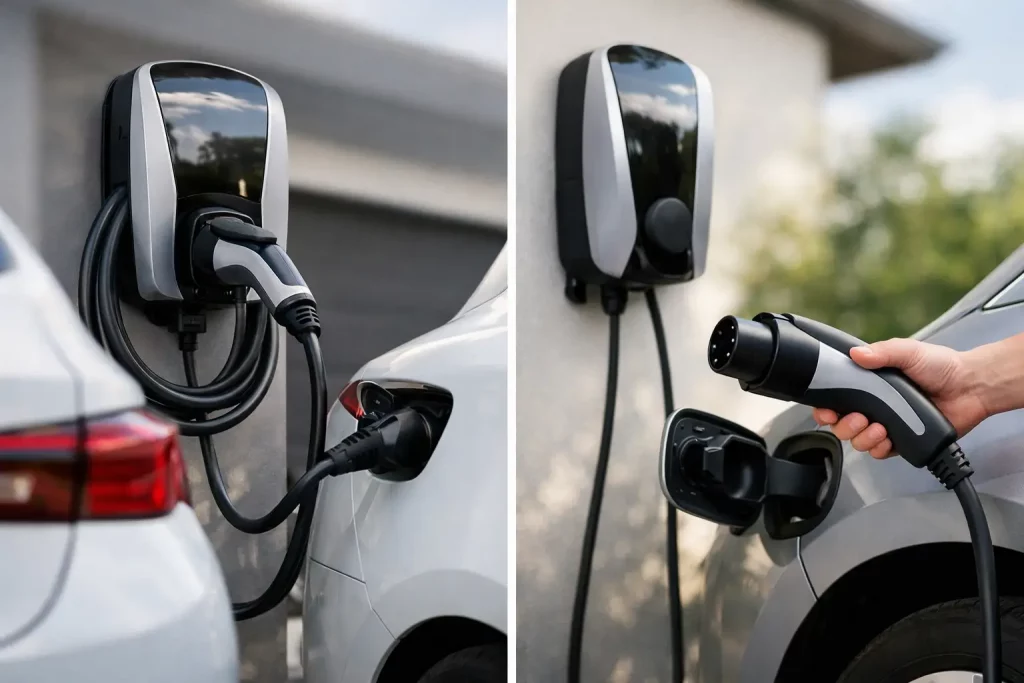
A tethered EV charger has a charging cable permanently attached to the unit. You simply park, take the connector from its holster and plug it into your car. Most UK tethered chargers use a Type 2 connector, which is compatible with the majority of modern electric cars and plug-in hybrids.
An untethered charger has a socket on the front rather than a fixed cable. You use the portable charging lead supplied with your vehicle, plugging one end into the charger and the other into the car. In the UK, this is typically a Type 2 socket.
The charging capability is not inherently different. A 7kW tethered charger and a 7kW untethered charger can deliver the same charging speed, provided the vehicle, electrical supply and installation are equivalent. The real decision is about convenience, appearance, cable management and how many different vehicles will use the point.
EV charger tethered vs untethered: the everyday experience
A tethered unit removes a small but meaningful step from your routine. The cable is already there, so charging takes seconds. This matters on dark winter evenings, during poor weather or when you arrive home with little time to spare. The cable can be neatly wrapped around the charger, keeping the driveway organised and ready for daily use.
The trade-off is that the cable remains visible. While modern units are designed to look tidy, a fixed five-metre or seven-metre lead is more noticeable than a compact socketed charger. Choosing the right cable length is important. It needs to reach your charging port comfortably without creating a trip hazard or trailing across a public pavement.
An untethered charger offers a more discreet finish when it is not in use. There is no permanent lead on the wall, which can suit a carefully designed frontage, a rental property or a commercial car park. The charging cable can be stored in the boot, garage or a dedicated cable bag.
However, you must retrieve, connect and put away that cable each time. That is hardly difficult, but it is less convenient when charging is a near-daily habit. A wet or muddy cable also needs handling and storage after use.
Tethered chargers suit routine home charging
If you normally charge the same vehicle on your own driveway, a tethered charger is usually the practical winner. It keeps the charging lead at the point of use and avoids relying on the vehicle cable being available, clean and undamaged.
This option is particularly useful for households using off-peak electricity tariffs. When your car needs to be connected before an overnight charging window begins, the easier the process is, the more likely you are to make the most of lower-cost electricity.
Untethered chargers suit flexible or shared parking
An untethered charger can make more sense where several drivers use the same charge point. Different EVs may have different preferred cable lengths, and visitors can use their own compatible lead. It can also be easier to replace a cable if it is lost or damaged, as the cable is not fixed to the charger itself.
For businesses, holiday lets and landlord-owned properties, socketed units can be a sensible choice. They give users flexibility while keeping the charger wall-mounted and uncluttered between charging sessions. Access control and smart charging features should still be considered, especially where electricity costs need to be managed fairly.
Cost, maintenance and security considerations
The price difference between tethered and untethered chargers varies by manufacturer, cable length and smart features. A tethered model can cost more because the cable and connector are included, although the gap is not always significant. An untethered unit may look less expensive at first, but you need to account for the cost of a suitable vehicle cable if one is not already supplied.
From a maintenance perspective, both options are designed for outdoor use when installed correctly. A tethered cable should be returned to its holster after charging rather than left on the ground, where it can collect dirt or become damaged. With an untethered unit, the same care applies to your removable lead.
Security is also worth considering. Tethered cables are generally locked to the car and charger while charging, depending on the model and settings. Untethered cables can be removed when charging is complete, so drivers should store them securely rather than leaving them outside. Neither format is automatically more secure in every situation, but good cable habits and an appropriate charger location make a real difference.
Compatibility and future flexibility
For most UK homeowners, Type 2 is the standard connection to expect. Before choosing a tethered charger, check the location of your vehicle’s charging port. A cable that reaches easily on one car may be inconvenient if you change to a vehicle with the port on the opposite side.
This is one of the strongest arguments for untethered charging. If your next vehicle needs a longer cable or has a different parking position, you can simply use a different compatible lead. That flexibility is valuable for households with changing vehicles or a mix of company cars, private EVs and plug-in hybrids.
That said, future-proofing should not be reduced to the cable alone. The charger’s smart functions, load balancing capability and electrical installation are often more important. A quality smart charger can schedule charging around lower tariff periods, monitor energy use and, where suitable equipment is installed, prioritise surplus solar electricity.
A typical single-phase domestic supply supports a 7kW charger, which is suitable for overnight home charging for many drivers. Some commercial sites and properties with three-phase power may be able to install 22kW charging, subject to supply capacity and vehicle capability. A professional survey establishes what is practical without overloading the property’s electrical system.
Choosing the right charger for solar and battery storage
If you have solar panels or are planning to install them, your EV charger should be selected as part of the wider energy system. Charging a car from surplus solar generation can reduce the amount of electricity you buy from the grid, particularly when the vehicle is at home during daylight hours.
Both tethered and untethered chargers can support solar-aware charging. The key question is whether the charger is compatible with your inverter, energy meter or control system, and whether its software can respond to available generation. Battery storage adds another consideration: you may want to reserve stored energy for evening household use, or use it for vehicle charging at selected times. The best setting depends on your tariff, driving mileage and household demand.
This is why choosing solely on cable style can lead to the wrong investment. A charger should fit the way your property generates, stores and uses energy, not just the make of car currently on the drive.
How to decide between tethered and untethered
Choose tethered if you want the quickest possible daily routine, have a regular parking position and mainly charge one vehicle. It is the familiar, ready-to-use option for busy households and can make overnight tariff charging feel effortless.
Choose untethered if a neat appearance matters, several different vehicles may use the charger or you want the freedom to select cable length as your needs change. It is also a strong option for shared residential and commercial settings where drivers may bring their own leads.
Whichever style you choose, do not compromise on the installation. The charge point needs a suitable electrical supply, correct protection, sensible cable routing and a location that works for how you actually park. It should also be specified for your vehicle, tariff and wider energy plans.
A well-chosen EV charger is not just a place to plug in. It can help you use lower-cost electricity, make better use of solar power and keep your property ready for the move to cleaner transport. Airtech Renewables can assess the practical details and install a solution that works reliably from the first charge onwards.