
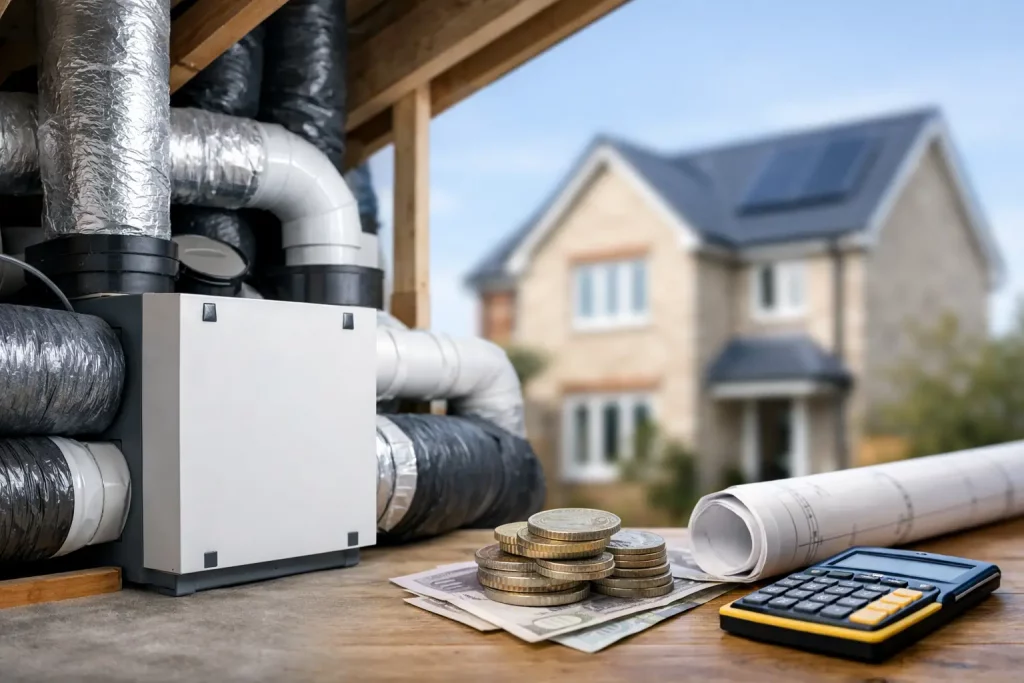
Poor ventilation is often noticed after the property is finished: steamed-up windows, lingering cooking smells, damp corners and rooms that feel stuffy despite regular cleaning. Understanding mvhr system installation cost early helps homeowners and developers plan a healthier, more efficient property without facing unexpected building work later.
Mechanical Ventilation with Heat Recovery, or MVHR, continuously removes stale, moisture-laden air from kitchens, bathrooms and utility rooms. At the same time, it supplies filtered fresh air to living spaces and bedrooms, recovering heat that would otherwise be lost through extract ventilation. It is particularly effective in well-insulated, airtight homes, where natural draughts no longer provide enough background ventilation.
What does an MVHR system cost to install?
For a typical UK home, a professionally designed and installed whole-house MVHR system commonly costs around £6,000 to £15,000 or more. The final figure depends on the size and layout of the building, the level of access available, the ductwork route, and whether the system is included during construction or fitted into an existing home.
A straightforward installation in a small new-build property may fall towards the lower end of that range. Larger homes, properties with several floors, complex room layouts or a premium heat recovery unit will cost more. Retrofitting an MVHR system into an occupied house can also increase labour costs because ceilings, floors or boxing may need to be opened and reinstated.
The unit itself is only one part of the investment. A complete quote should cover the ventilation unit, correctly sized ductwork, valves and grilles, external terminals, condensate drainage, electrical connections, controls, commissioning and balancing. The quality of the design and commissioning matters as much as the equipment chosen. An undersized or poorly balanced system can be noisy, inefficient and unable to deliver the airflow the property needs.
MVHR system installation cost breakdown
Every property needs an individual survey, but the broad cost areas below explain where the budget goes.
The MVHR unit
The central unit recovers heat from extracted air before it leaves the building. Prices vary with capacity, fan efficiency, filter quality, controls, noise levels and manufacturer. A compact unit for a smaller property will usually cost less than a high-capacity model serving a large family home or commercial space.
Choosing the cheapest unit is not always the best route to value. A suitably specified, efficient unit can reduce running costs, provide better filtration and operate more quietly over the long term. It should be selected to match the calculated airflow requirement, rather than simply the number of bedrooms.
Ductwork and distribution
Ductwork is frequently the largest variable in an MVHR installation quote. The system needs supply ducts to habitable rooms and extract ducts to wet rooms, along with carefully planned routes back to the central unit.
New builds and major renovations are generally the most cost-effective projects because ductwork can be installed before plasterboarding and finishes are completed. In a retrofit, restricted loft space, solid floors, decorative ceilings and limited service voids can make routes more difficult. A good installer will identify practical routes before work begins and explain where discreet boxing or access work may be required.
Design, installation and commissioning
MVHR is not a fit-and-forget appliance. The system should be designed around the property, including room use, occupancy, insulation levels and available duct routes. Installation then needs to be completed to a high standard, with ducts properly sealed and insulated where necessary.
Once fitted, each supply and extract point must be tested and balanced. This commissioning process makes sure that stale air is removed effectively without creating excessive noise or draughts. It also helps demonstrate compliance with ventilation requirements under Building Regulations.
Building work and electrical work
Some projects require additional work that may not be obvious at first. This can include creating external wall penetrations, fitting roof terminals, making good ceilings, constructing a cupboard around the unit, upgrading electrical supplies or installing a condensate drain.
Ask whether these items are included in the quotation. Comparing two prices without checking the scope can be misleading. A lower initial quote may exclude essential ductwork, controls, commissioning or reinstatement work.
New build versus retrofit installation
The difference between new build and retrofit is one of the biggest influences on cost.
In a new build, extension or full refurbishment, MVHR can be incorporated into the building design. Duct runs can sit within ceilings, service zones and floor voids, which helps keep installation tidy and reduces labour time. It also gives the best opportunity to create an airtight, energy-efficient home where heat recovery ventilation delivers its full benefit.
Retrofitting can still be worthwhile, especially where a property suffers from condensation, mould risk or poor indoor air quality. However, it needs realistic planning. A whole-house MVHR system is often most practical when combined with substantial renovation work, loft conversion, re-roofing or internal alterations. For a home where access is limited, decentralised heat recovery units or targeted extract ventilation may sometimes be a more suitable option.
What affects the price of an MVHR quote?
The size of the home matters, but it is not the only factor. A compact three-bedroom house with clear loft access may be simpler to ventilate than a smaller property with multiple extensions and no obvious duct routes.
The main price drivers include the number of wet rooms, building layout, number of storeys, location of the MVHR unit, distance to external terminals, ductwork access and the required airflow rate. Higher levels of airtightness can improve performance, while poorly sealed ductwork or unwanted gaps in the building fabric can reduce the expected benefit.
Noise control also deserves attention. Correct duct sizing, sensible unit positioning and well-designed airflow routes help keep operation unobtrusive. Placing a unit directly beside a bedroom, for example, may save a short length of ductwork but create an avoidable comfort issue.
For landlords and commercial property owners, usage patterns can affect the specification too. A busy shared property, office, salon or changing facility may need a different ventilation strategy from a standard family home.
Is MVHR worth the investment?
MVHR is primarily an investment in healthier indoor air and better comfort. It provides controlled ventilation without relying on open windows, which can be valuable near busy roads, in urban areas or during colder months. Filters help reduce incoming pollen, dust and outdoor particulates, although they must be checked and replaced as part of regular maintenance.
The energy benefit comes from recovering heat from outgoing air. In an airtight, well-insulated property, this can reduce the heat lost through conventional extract ventilation and support lower space-heating demand. Results vary according to the home, heating system, occupant behaviour and system settings, so it should not be treated as a guaranteed bill-saving figure in isolation.
MVHR works particularly well alongside low-carbon systems such as an air source heat pump, underfloor heating and solar generation. These technologies address different parts of a property’s energy performance: ventilation, heating comfort and electricity use. Planning them together can avoid clashes between services and create a more efficient overall design.
How to get an accurate installation price
An accurate quote starts with a proper survey, not a guess based only on floor area. The installer should consider the plans or existing layout, identify viable duct routes, assess the building fabric and confirm where the unit, intake and exhaust terminals will be located.
Provide details of any planned insulation upgrades, new windows, extensions or heating changes. These can affect both the MVHR design and the best time to install it. If you are renovating, arranging the ventilation design before first-fix electrical and plasterboarding work can prevent delays and unnecessary remedial costs.
It is also sensible to ask what handover includes. You should receive clear operating guidance, information on filter changes and evidence that the system has been commissioned. A system that is easy to understand is more likely to be used correctly and deliver the air quality benefits it was designed for.
For homeowners, developers and businesses, the best approach is to treat MVHR as part of the building, rather than an add-on at the end of a project. Airtech Renewables can help assess how ventilation fits with your wider plans for heating, solar, storage and home comfort, so the investment is designed around the property from the start.