
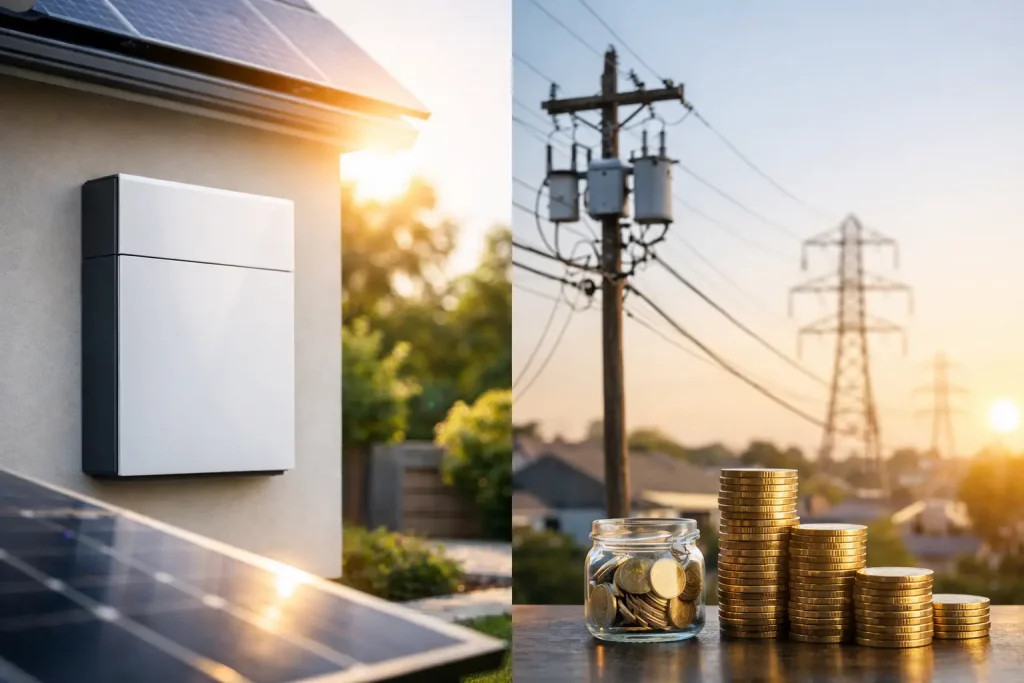
A solar battery vs export tariff decision comes down to one practical question: is it better value to keep unused solar electricity for your own property or sell it to the grid? There is no single answer for every UK home or business. The right choice depends on when you use electricity, the tariff available to you and the size of your solar system.
For many properties, the strongest result is not an either-or decision. Solar panels, a well-sized battery and a competitive export tariff can work together to reduce imported electricity while still earning money from surplus generation.
Solar battery vs export tariff: the core difference
Solar panels generate the most electricity in the middle of the day. Unfortunately, that is often when homeowners are out, businesses may have lower demand, and household electricity use is relatively modest. Any power that is not used immediately has two possible destinations: it can be stored in a battery or exported to the grid.
A solar battery stores surplus energy so it can be used later, such as during the evening when lighting, cooking, televisions and appliances increase demand. This reduces the amount of electricity you need to buy from your supplier at the full import rate.
An export tariff pays you for electricity sent from your solar system to the grid. Most eligible solar installations use the Smart Export Guarantee, commonly known as SEG. Rates vary significantly between suppliers and tariff types, so the value of exporting one unit of electricity is not fixed.
The comparison is therefore not simply battery cost versus export income. It is the value of one unit of stored electricity against the income you would have received by exporting it.
When a solar battery is likely to save more
A battery is often most valuable where the cost of buying electricity is much higher than the payment for exporting solar power. For example, if you would otherwise export a unit for 10p but later need to buy a unit from the grid for 25p, storing that energy can be worthwhile.
There are losses involved in charging and discharging a battery, so you do not get every unit back. A typical system will retain most, but not all, of the electricity stored. Even allowing for this, avoiding high-priced grid imports can deliver meaningful savings where evening electricity use is substantial.
A battery may suit your property particularly well if you regularly use power after sunset, work from home, run an EV charger, or have high evening demand from a family household. It can also complement an air source heat pump, helping you use more of the electricity generated on site when your heating system requires power.
The benefit is not limited to solar generation. With the right electricity tariff and battery controls, some households can charge their battery from lower-cost off-peak grid electricity and use it at more expensive times. This approach needs careful planning. It only makes sense if the difference between off-peak and peak prices is large enough to cover battery losses and any tariff conditions.
When exporting your solar electricity can be the better option
Exporting can be the more attractive route when you have access to a strong export tariff and your battery would have limited opportunity to reduce imports. A small household with low evening demand, for example, may not use enough stored energy to justify a larger battery.
Some tariffs pay a higher rate for exported electricity at certain times. If your export payment is close to, or higher than, the price you would pay to import electricity, keeping every spare unit in a battery may not be the best financial decision. A smart system can be configured to respond to these price signals rather than following a fixed rule.
Export income also has the advantage of requiring no extra storage hardware. If your priority is the lowest upfront cost, solar panels paired with an export tariff can provide a straightforward route to lower bills and an additional income stream.
However, export rates can change. Suppliers may alter their offers, and the highest-paying tariffs can come with conditions that do not suit every household. It is sensible to compare tariffs based on their wider electricity pricing, not the export figure alone.
Compare the value per unit, not just the tariff headline
The most useful calculation is based on the value of each kilowatt-hour, or kWh, of surplus solar electricity. Ask what you receive if you export it, then compare that with what it costs to buy a usable unit of electricity from the grid later.
Suppose your import electricity costs 28p per kWh and your export tariff pays 12p per kWh. If a battery returns around 90% of the electricity put into it, one exported kWh would become roughly 0.9 kWh available for later use. Avoiding 0.9 kWh of imported electricity could be worth about 25p. After allowing for the 12p export income you gave up, the potential extra value is around 13p per kWh stored.
That does not automatically mean a battery will pay for itself quickly. Battery capacity, installation cost, warranty, expected daily usage and future tariff changes all matter. But it shows why a battery can be compelling for properties that export heavily at low rates and buy significant electricity after dark.
The reverse can also be true. If an export tariff pays 25p per kWh and the electricity you displace is worth 28p per kWh, storage losses leave little financial advantage in storing solar energy. In that situation, exporting may be the sensible choice at those times.
Battery size matters more than many people expect
Buying the largest battery available is rarely the most cost-effective approach. An oversized battery may spend much of the year partly empty because your solar array does not generate enough surplus electricity to fill it, especially in winter. A battery that is too small, on the other hand, may fill by late morning and leave you exporting valuable excess power for the rest of the day.
The right size should reflect your solar generation, daytime consumption, overnight demand and future plans. An EV, heat pump, electric hot water cylinder or growing family can all change the picture. Commercial properties also need a different assessment, as their electricity demand may be strongest during solar-producing hours, reducing the need for storage.
A tailored design should consider half-hourly consumption data where possible. This reveals when electricity is used, rather than relying on an annual bill total that can hide expensive peaks and unused solar opportunities.
A combined approach often delivers the best result
For many UK properties, the best answer to solar battery vs export tariff is to use both strategically. Use solar electricity directly first, because this usually delivers the greatest immediate value. Store surplus when the avoided cost of importing later is higher than the export payment. Export remaining power when the battery is full or when export rates make selling more attractive.
Smart monitoring and battery controls make this easier. They can prioritise household demand, protect a reserve level for the evening, charge during off-peak periods where appropriate and export power when it is financially favourable. The goal is not simply to maximise storage or export. It is to reduce your total energy cost.
What to check before making your decision
Before choosing battery storage or relying mainly on export payments, check your current import tariff, realistic SEG options and your daily electricity pattern. Look at how much solar power you are likely to generate in summer and winter, as storage benefits will naturally vary through the year.
Also consider the battery warranty, usable capacity and expected lifespan. A quality installation should be designed around your property rather than a standard package. MCS-certified solar installation is also important for accessing SEG payments, subject to supplier requirements.
For landlords and businesses, the decision should include how the system supports wider operating costs. A battery can help manage demand after solar hours, while export may offer a simpler option for sites with limited on-site consumption.
Airtech Renewables can assess solar generation, consumption and future energy plans to recommend a system that makes commercial sense for your property. The most valuable solar setup is the one that puts each unit of electricity to its best use – whether that means using it, storing it or exporting it at the right time.