
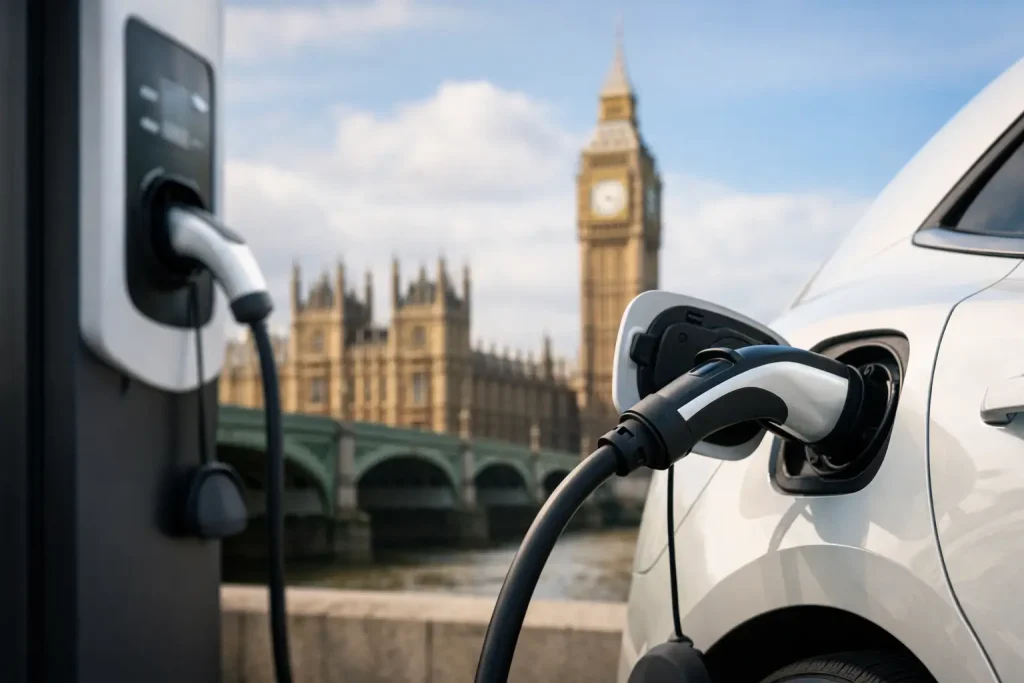
An EV charger is not simply a new socket on the side of a house or in a car park. It is a high-load electrical installation that must work safely with your property, supply capacity and daily energy use. This guide to EV charger regulations explains what UK homeowners, landlords and businesses need to consider before choosing a charger or booking an installation.
The right approach protects your property, avoids unexpected upgrade costs and gives you a charging setup that is ready for smarter energy use – especially if you have, or plan to add, solar panels and battery storage.
What this guide to EV charger regulations covers
EV charging rules differ depending on where the charger will be installed and who will use it. A private driveway charger has different considerations from a shared residential car park, workplace or customer-facing charging bay. However, the central requirement is consistent: the equipment and installation must comply with current electrical safety standards.
In Great Britain, EV charger installations are generally designed and installed in line with BS 7671, commonly known as the IET Wiring Regulations. Section 722 specifically deals with electric vehicle charging installations. This covers matters such as circuit design, earthing arrangements, protection against electric shock and the location of charging equipment.
A reputable installer will assess these details before work starts rather than treating the charger as a standard outdoor electrical accessory. This is particularly important in older properties, where consumer units, earthing systems or incoming electrical supplies may not be suitable without additional work.
Home EV charger rules: safety comes first
For most homeowners, a dedicated off-street parking space is the simplest place to install a charge point. The charger should be connected to its own appropriately protected circuit, rather than sharing a circuit with other household equipment. Your installer will check the condition and capacity of your consumer unit, the route for cabling and whether the supply can support the additional demand.
Earthing and electrical protection
EVs can create electrical conditions that require specialist protection. One key issue is a potential fault involving the combined neutral and earth system used by many UK electricity networks. Depending on the property and charger selected, the installation may need built-in protective measures, an earth electrode or another compliant solution.
This is one reason a plug-in extension lead or unsuitable outdoor socket is not a sensible long-term charging arrangement. A purpose-designed charger offers controlled charging, durable weather protection and the electrical safeguards required for regular vehicle use.
Your installer should also provide an Electrical Installation Certificate once the work is complete. Keep this with your property records. It is useful for future electrical work, insurance queries, house sales and demonstrating that the charger was installed correctly.
Building regulations and planning considerations
Electrical work at a home may be notifiable under building regulations. In England and Wales, work is commonly notified through a registered competent person installer or, where required, through local authority building control. Scotland and Northern Ireland operate under different building standards arrangements, so local requirements should be checked before work begins.
Many domestic charge points can be installed without a planning application, particularly where they sit within the property boundary. That does not mean planning can always be ignored. Listed buildings, conservation areas, flats, shared driveways and properties with unusual access arrangements can require additional permissions or consent.
A charger should also remain within your land. Running a cable across a pavement to charge a vehicle parked on the road can create a trip hazard and may breach highway rules. Some councils operate pavement cable channel schemes, but these are local arrangements rather than a universal right.
Smart charging is a legal requirement for most new private chargers
The Electric Vehicles Smart Charge Points Regulations require most charge points sold for private domestic or workplace use in Great Britain to have smart functionality. In practical terms, the charger should be able to receive and react to information, allow scheduled charging and include security measures that protect the device and its data.
Smart charging helps avoid pressure on the electricity network at peak times. It can also reduce running costs when your tariff offers cheaper overnight electricity. If your home has solar panels, a compatible smart charger may be able to prioritise surplus generation, helping you put more of your own electricity into your vehicle rather than exporting it to the grid.
There are limited exemptions, so it is best to assume a compliant smart charger is needed unless an experienced installer confirms otherwise.
Workplace, landlord and commercial charger requirements
A workplace charger needs more planning than a single domestic unit. Businesses must consider the electrical capacity of the site, the number of vehicles expected to charge, how bays are managed and whether staff, visitors or fleet drivers will use the equipment.
For a small office, one or two managed chargers may be suitable without major supply changes. For a busy commercial site, adding several 7kW units at once can significantly increase demand. Load balancing allows chargers to share available power intelligently, reducing the risk of overloading the building supply and potentially avoiding costly network upgrades.
Landlords should obtain the correct property and leaseholder permissions before installation. In blocks of flats, the freeholder, managing agent and other residents may need to be involved, particularly where cabling passes through communal areas or chargers are installed in shared car parks. Clear rules on access, electricity billing and maintenance prevent disputes later.
New-build projects should also consider EV charging early. Building regulations include requirements for electric vehicle charging infrastructure in certain new residential and non-residential developments, as well as major renovations. The precise requirement depends on the building type, parking provision and location within the UK. Designing routes, containment and electrical capacity at the construction stage is far more affordable than opening up finished surfaces later.
For workplaces and commercial sites, a proper installation plan should cover bay markings, cable management, lighting, accessibility and safe traffic movement as well as the electrical work. If chargers are available to customers or the public, further operational rules may apply.
Rules for public and customer-facing chargers
Public charging is subject to additional requirements under the Public Charge Point Regulations in Great Britain. These rules are designed to make public charging clearer and more reliable for drivers.
Depending on the charger power, age and network type, operators may need to meet requirements around transparent pricing, payment methods, reliability targets, customer support and the availability of charging data. Rapid charging hubs are subject to particularly significant expectations because drivers often depend on them during longer journeys.
For a retailer, hotel, leisure venue or business car park, this means the decision is not only about fitting hardware. You need a suitable operator, a maintenance plan and a clear approach to customer payments. A free staff-only charger is a different proposition from a paid service open to every driver, and the compliance route should reflect that from the outset.
Network approval, grants and choosing the right installer
Your local electricity network operator must be considered as part of the installation process. Installers assess the existing supply and notify the network operator where required. In some cases, particularly with larger commercial installations or properties with limited supply capacity, approval or a supply upgrade may be needed before the charger can operate at the desired power.
Do not choose a charger based on its maximum rating alone. A 7kW home charger is often the practical choice for overnight charging, while a three-phase supply can support faster charging where available. Higher power can be useful, but it may cost more to install and may not deliver a meaningful benefit if the vehicle itself has a lower AC charging limit.
Grant support can improve the business case, but eligibility changes over time. Homeowner grants are limited, while support may be available for landlords, tenants, businesses and certain residential properties through schemes administered by the Office for Zero Emission Vehicles. Grant-funded work normally needs to be completed by an authorised installer and use eligible equipment. Check current criteria before relying on grant funding in your budget.
When comparing quotations, look beyond the headline charger price. Ask whether the quote includes the electrical survey, cable route, consumer unit work, earthing solution, network notification, certification and commissioning. These details determine whether a low initial figure is genuinely good value.
A qualified installer should explain the available options in plain English and recommend a system that suits your parking arrangement, electrical supply and plans for solar or battery storage. Airtech Renewables can help property owners bring these elements together, so charging works as part of a wider low-carbon energy system rather than as an isolated upgrade.
Make the charger work harder for your property
The best EV charger installation is one that remains safe, compliant and affordable to run long after the fitting date. Start with a proper site survey, choose equipment that supports smart scheduling and plan for how your energy needs may change over the next few years. A well-designed charger can reduce the cost of driving electric while making your home or business better prepared for cleaner, more independent energy use.